


































Fast, reliable internet is now the backbone of Michigan companies: it keeps cloud apps humming, point-of-sale terminals ringing, and Zoom calls crisp.
Most businesses can choose among four wired providers at a single address, according to the FCC’s 2025 Broadband Deployment Report. Choice should empower you, yet glossy promos rarely reveal symmetry, uptime, or price per megabit.
We sifted through those filings, carrier price sheets, and live performance data to spotlight fiber plans that perform. You will see clear speed tiers, SLAs, fees, and support details—so you can sign the right contract and get back to work.
How we selected Michigan’s top fiber providers

We put every contender through the same five-point stress test.
First, we mapped availability. We favored networks that reach at least one-third of Michigan business addresses.
Second, we examined speed and symmetry. Plans had to deliver gigabit-class downloads with matching uploads; slower uploads choke cloud backups and video calls.
Third, we required a published service level agreement. A 99.99 percent uptime pledge allows fewer than five minutes of downtime per month, and anything looser failed the cut.
Fourth, we compared price per megabit and contract terms. In Michigan you can land 5 Gbps service for about $285 a month, so inflated rates or strict multi-year lock-ins counted against a provider, according to BroadbandNow pricing data.
According to WOW! Business’ Fiber Flex product overview, the shared-fiber service undercuts typical dedicated links while still bundling a guaranteed SLA and round-the-clock local support.
Findings like that proved carriers can trim rates without skimping on reliability, and they scored well in our comparison.
Finally, we weighed support and extras. Round-the-clock help desks, local field techs, static IP blocks, and LTE failover tilted the scales.
Only the companies that cleared every bar earned a place in the deep dive that follows.
Michigan fiber providers at a glance
Before we dig into each company, the snapshot below shows who covers your ZIP code and how their core specs line up. Review the grid, mark the names that serve your address, and keep it handy for the deep dives that follow.
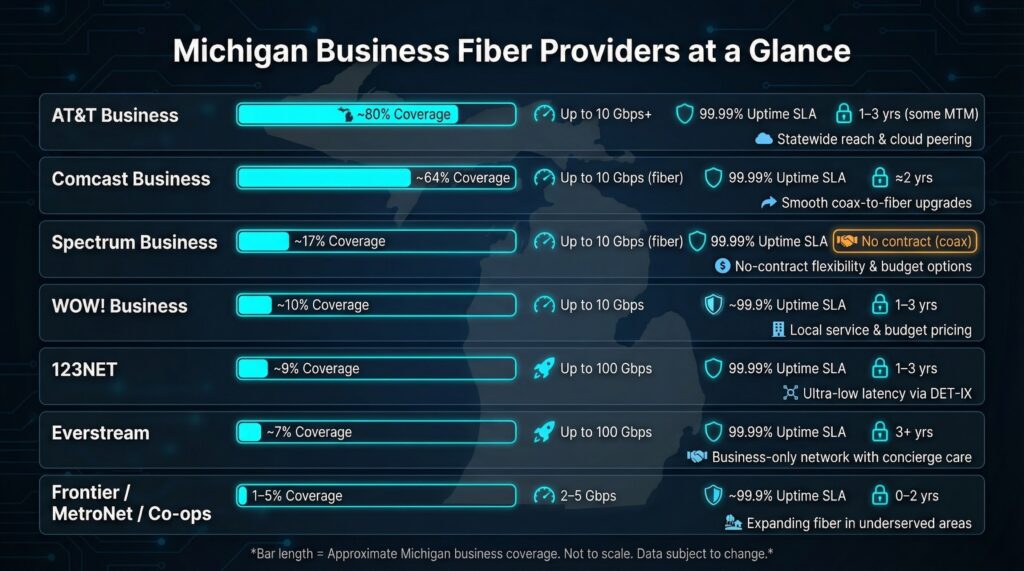
| Provider | MI business coverage | Max symmetric speed | Uptime SLA | Typical contract | Standout strength |
| AT&T Business | ~80 percent | 10 Gbps+ | 99.99 percent | 1–3 years (month-to-month on some tiers) | Statewide reach and cloud peering |
| Comcast Business | ~64 percent | 10 Gbps (fiber) / 1.2 Gbps (coax) | 99.99 percent on fiber | ~2 years | Smooth coax-to-fiber upgrade path |
| Spectrum Business | ~17 percent | 10 Gbps (fiber) / 1 Gbps (coax) | 99.99 percent on fiber | None on coax | No-contract flexibility |
| WOW! Business | ~10 percent | 10 Gbps | 99.9 percent | 1–3 years | Local service and budget pricing |
| 123NET | ~9 percent (on-net) | 100 Gbps | 99.99 percent | 1–3 years | Ultra-low latency through DET-IX |
| Everstream | ~7 percent | 100 Gbps | 99.99 percent | 3 years+ | Business-only network with concierge care |
| Frontier / MetroNet / Co-ops | 1–5 percent (combined) | 2–5 Gbps | ~99.9 percent | 0–2 years | Expanding fiber in underserved areas |
Keep this table close when sales reps pitch “limited-time” deals.
AT&T Business: statewide reach and enterprise-grade reliability
Need fiber at every branch? AT&T covers about 80 percent of Michigan business addresses, from downtown Detroit to clinics along US-131.
Speed options scale with growth. Shared fiber starts at symmetrical 300 Mbps, while a 5 Gbps tier runs about $285 per month. Dedicated circuits exceed 10 Gbps for banks, hospitals, and SaaS teams.

Every dedicated link carries a 99.99 percent uptime pledge—less than five minutes of monthly downtime. Add optional 5G or LTE failover, and even a back-hoe cut rarely takes you offline.
Support matches the network. A 24 × 7 operations center watches every circuit and dispatches Michigan-based techs when alarms trigger. Many shared tiers bill month-to-month, so you keep flexibility without forfeiting resilience.
Choose AT&T when coverage and consistency matter more than chasing the lowest sticker price. For multi-site firms or any company that lives in the cloud, the statewide backbone delivers peace of mind.
Comcast Business: start on cable, graduate to fiber
Comcast’s strength is convenience. Coax lines already reach about 64 percent of Michigan commercial addresses, so a 300 or 600 Mbps install can finish in days, not weeks. The gateway modem doubles as a Wi-Fi router, which helps small teams get online quickly.
When your uploads need parity, the same rep can quote Ethernet Dedicated Internet up to 10 Gbps with a 99.99 percent SLA. Both services share the core network, so the move often means swapping in a fiber jumper and signing a new contract, not digging up the street.
Resilience also counts. Business gateways offer automatic 4G or 5G failover, and neighborhood nodes include battery backups. Even during a power flicker, your video call stays live.
Pick Comcast when speed today matters and a clear path to symmetric fiber tomorrow justifies a two-year term.
Spectrum Business: contract-free internet for mid-Michigan and beyond
Spectrum serves about 17 percent of Michigan business addresses, with clusters in Kalamazoo, Lansing, and lakeshore towns.
Cable installs usually finish in under a week. After the tech connects the coax, you can reach up to 1 Gbps download on a simple month-to-month bill. When the season ends, return the modem and leave without a fee.
Performance holds steady because the cable network rides a fiber backbone. If you need symmetric uploads later, the enterprise desk can quote fiber up to 10 Gbps with a 99.99 percent SLA.
Many IT teams keep Spectrum cable as a backup since it follows different poles and a separate path from their primary fiber line.
Choose Spectrum when a short lease or pop-up site needs reliable bandwidth without a long contract.
WOW! Business: local service, enterprise muscle
WOW! started as a Midwest cable upstart and now threads fiber through Livonia, Lansing, and Detroit’s suburbs, reaching about 10 percent of Michigan business addresses.
Support feels hometown. Calls route to U.S. agents who know the difference between Twelve Mile and Eight Mile, and field techs arrive with authority to resolve issues on the spot.
Entry-level coax touches 1 Gbps down, but the standout is Fiber Flex: symmetrical tiers from 500 Mbps to 10 Gbps, each backed by a 99.9 percent uptime pledge. Those tiers unlock six business fiber internet advantages that go beyond raw speed: generous bandwidth headroom, true symmetry, near-perfect uptime, stronger security, ultra-low latency, and effortless scalability. Even with those perks, Fiber Flex still costs less than comparable plans from national giants, so teams get enterprise capacity without corporate paperwork.
Add voice or managed Wi-Fi, and all services land on one tidy invoice, a relief for lean finance teams.
Choose WOW! if you are inside its footprint and value quick human help as much as raw bandwidth.
123NET: Detroit-born fiber built for heavy uploads
Headquartered in Southfield, 123NET weaves more than 4,500 route-miles of fiber through Michigan’s commercial core and lights 250-plus buildings from downtown Detroit to Grand Rapids.
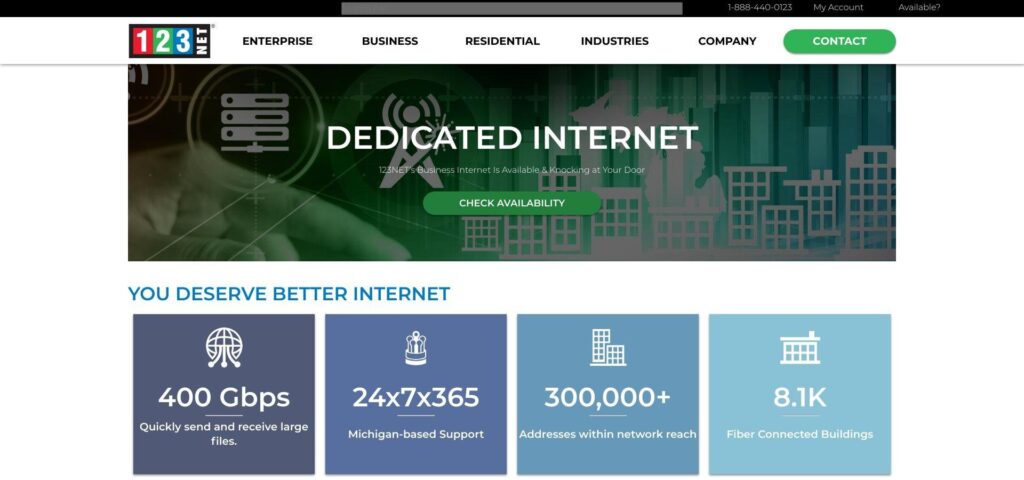
Every circuit is true fiber. Service begins at a symmetrical 1 Gbps, then scales to 10, 40, or even 100 Gbps for firms that move terabytes overnight. A 99.99 percent uptime pledge and direct peering at the Detroit Internet Exchange keep latency in the single-digit millisecond range, so cloud desktops feel local.
Support matches the speed. When you call the network operations center, an engineer—not a script reader—answers, often on the first ring. Need dark fiber to a partner site? You will meet the person who splices it.
For teams that rely on fast uploads—video post-production, research data syncs, fintech trading—123NET turns connectivity into a competitive edge, not just an expense line.
Everstream: business-only fiber with concierge care
Everstream entered Michigan by acquiring Rocket Fiber and then expanding its own build. Today the all-fiber network reaches about seven percent of business addresses in Detroit, Ann Arbor, and Grand Rapids, and serves companies only. No residential movie nights share your packets.
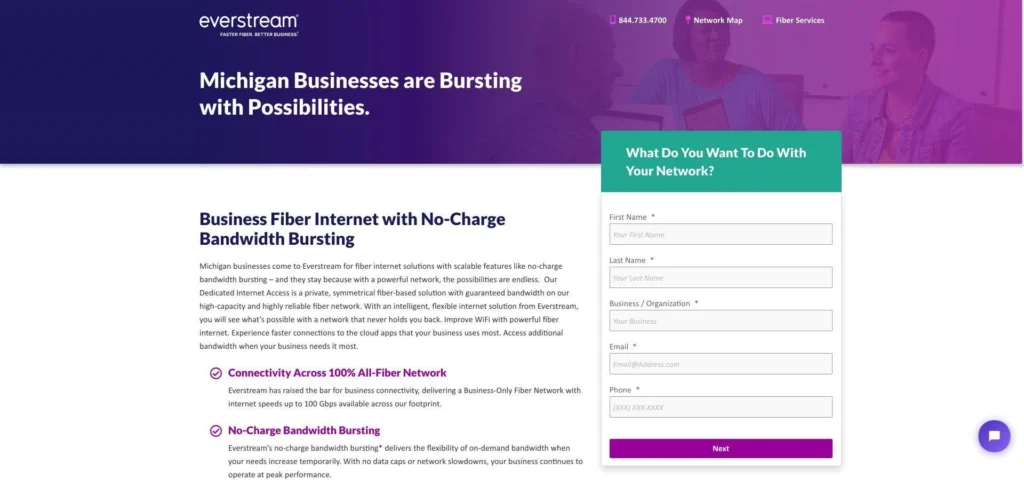
Every circuit is symmetrical and burstable. You may order 1 or 10 Gbps, yet the link can spike higher during large transfers without surprise overage fees. Dual, diverse paths travel in separate conduits, so a single back-hoe cut rarely affects uptime. The SLA promises 99.99 percent availability.
Service feels boutique. A dedicated engineer learns your topology, provides a direct number, and resolves tickets without tier-one scripts. If the building is already on-net, installation often finishes within 30 days—far quicker than many legacy telcos.
Everstream costs more than coax, but buyers pay for zero congestion, sub-5 ms latency, and humans who answer the phone. For midsize manufacturers, regional law firms, or SaaS teams that cannot risk jitter, the math is simple: pay for a clean pipe and sleep well.
Frontier, MetroNet, and local co-ops: fiber options beyond the big metros
Not every business sits on a downtown backbone. When larger carriers show “service unavailable,” regional players often fill the gap.
Frontier has replaced copper with gig-speed fiber in parts of southwest and northeast Michigan. Coverage is spotty, yet streets that are lit can see near-residential pricing and month-to-month terms.
MetroNet takes a different tack, building 100 percent fiber in midsize cities such as Novi and Portage. A five-gig symmetrical plan can cost less than a downtown parking pass, and no term agreement is required.
Electric co-ops and municipal networks like Midwest Energy’s MiFiber or Lakeshore Fiber string lines through low-density townships. Monthly rates sit higher, but for rural manufacturers and tourism operators, any gigabit option beats coax capped at 25 Mbps.
If your address is off the beaten path, check these niche providers before assuming fiber is out of reach. You may find a hometown operator eager to win your business and keep dollars in the community.
Why fiber leaves cable and DSL in the dust
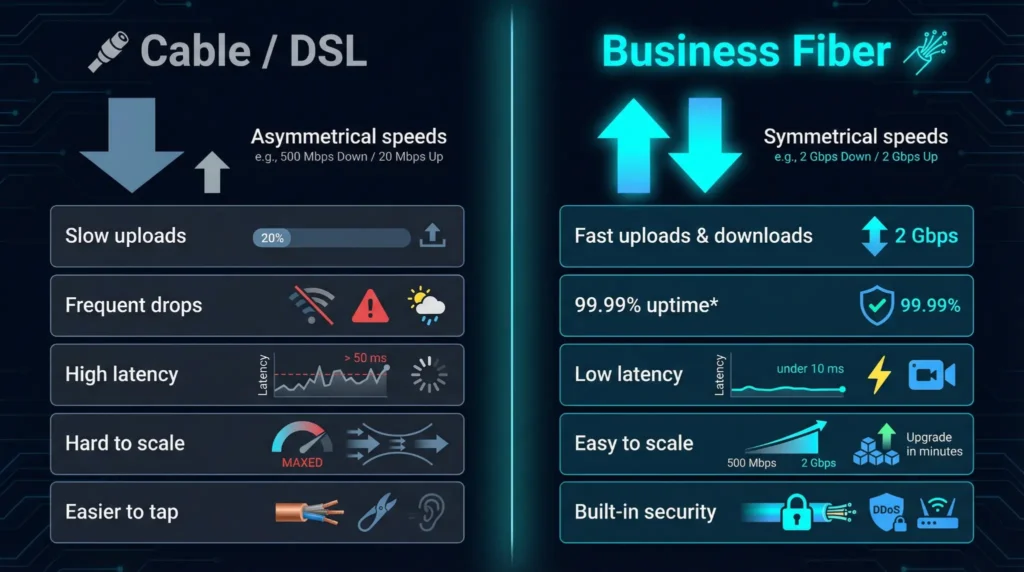
1. Symmetrical speeds fuel modern workflows
Cable provides a wide pipe in one direction and a straw in the other. That imbalance slows cloud backups, large file uploads, and simple tasks such as sending a 4K video to a client.
Fiber offers equal upload and download rates—500 Mbps, 1 Gbps, or more—so data moves both ways in seconds. Designers push revisions without watching progress bars, architects sync models before meetings, and daily off-site backups finish well before morning coffee.
Teams notice the change at once. Video calls stay sharp while someone uploads a project, and remote colleagues stop complaining about lag.
2. Reliability keeps revenue rolling
Copper lines pick up electrical noise, shared cable nodes congest, and both struggle when a squirrel treats the utility pole as a playground. Light signals inside glass fiber ignore that interference, so service stays steady.
Business-grade fiber often carries a 99.99 percent uptime pledge. Pair that with proactive monitoring and four-hour repair targets, and “internet is down” fades from office chatter.
3. Low latency makes real time feel real
Every extra millisecond forces a video call to buffer or a remote desktop to hesitate. Fiber shortens those pauses. In Michigan, round-trip times under 10 ms to Midwest cloud hubs are common, so conversations feel face-to-face and cloud apps react instantly.
4. Scalability prepares you for growth
Hiring a new design team or rolling out 4K security cameras can double bandwidth needs overnight. On cable or DSL, that means ordering a new circuit and waiting for a truck roll. With fiber, the existing strand already supports multi-gig speeds; scaling often involves a quick port change at the provider’s switch.
Your 500 Mbps link can become 2 Gbps before lunch, no construction crew required.
5. Built-in security protects data and reputation
Tapping a fiber strand breaks the light path and triggers alarms at the provider’s monitoring center. Copper can be clipped and tapped with little evidence.
Most business fiber packages add software defenses as well: static IP blocks for clean firewall rules, DDoS scrubbing at the network edge, and managed routers that patch themselves. For companies handling payment data, HIPAA files, or proprietary designs, that physical and digital security is worth the rate.
How to choose the right plan
Picking a provider is simpler when you break the decision into five moves.
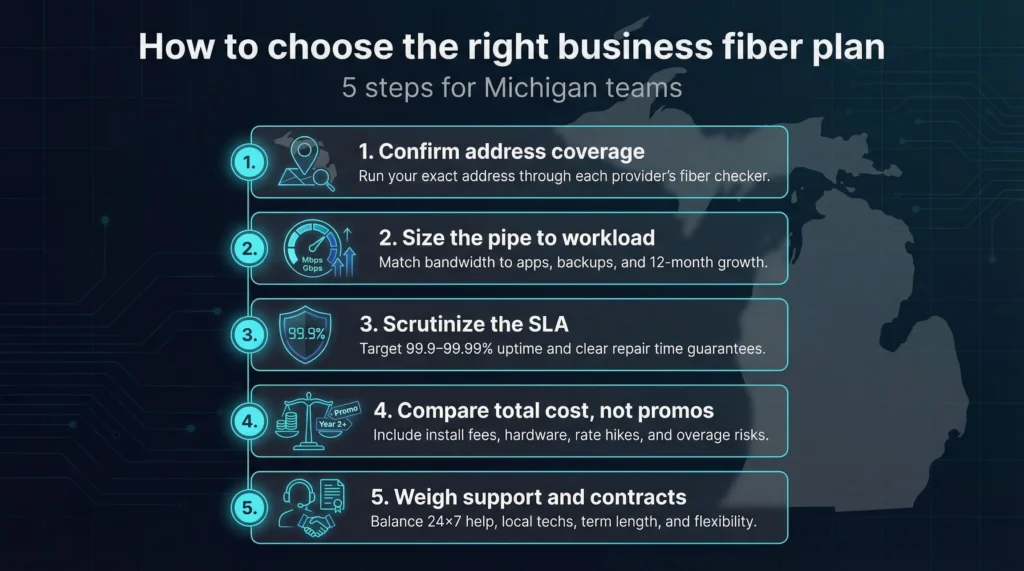
Confirm availability at the exact address. Fiber can stop halfway down the block, so run your ZIP through each ISP’s checker before you commit.
Size the pipe to your workload. Email and point-of-sale traffic run fine on 300 Mbps, but a design studio rendering 8K video needs at least a gig. Add a twelve-month growth cushion so you upgrade on your schedule, not in a rush.
Scrutinize the SLA. Look for 99.9 percent uptime at minimum and ask how credits apply if the carrier misses the target. Hospitals and banks often require 99.99 percent and a four-hour repair window.
Compare total cost of ownership, not just promo rates. A 5 Gbps AT&T Business Fiber circuit lists at about $285 per month (roughly fifty-seven dollars per gigabit). Stack that against coax plans where uploads crawl and rates jump after year one.
Weigh support and contract terms. Month-to-month service feels flexible until you need after-hours help and discover the carrier charges extra. A three-year fiber deal may lock price and include free install. Match the fine print to your risk tolerance, and the best option will surface.
Frequently asked questions
Is fiber available in rural Michigan?
Coverage is expanding fast thanks to state and federal grants. Electric co-ops and niche providers now pull gig-speed lines past farms and lake houses once limited to DSL. Always run your address through multiple checkers—you may be surprised.
What does a 99.99 percent SLA mean?
It allows about four and a half minutes of unplanned downtime per month. If an outage runs longer, the carrier owes service credits. Critical operations such as hospitals, banks, and e-commerce sites treat that pledge as essential.
How much should a small business budget for fiber?
In most Michigan metros, plan on $70–$110 per month for 300–500 Mbps shared fiber and roughly $160–$300 for a dedicated gig. Multi-gig circuits scale from there. Carriers often waive construction fees if you commit to a multi-year term.
Do I need fiber, or will cable do?
If your team sends invoices and streams background music, cable is fine. Once you push large uploads, rely on crystal-clear video calls, or expect fast head-count growth, fiber’s symmetry and reliability save enough time to outweigh the price gap.
Conclusion
Michigan’s fiber landscape is broad and competitive, giving businesses across the state a real chance to align budget, performance, and support. Use the comparison grid, weigh uptime promises, and match contract terms to your growth plans. With the right provider, your connection becomes another strategic asset—not a daily worry.