


































AI agents have left the lab and moved into the contact-center core. TechRadar calls 2026 “the true enterprise agent era,” as autonomous platforms jump from pilots to millions of monthly conversations. At that scale, a bot must resolve issues, escalate edge cases with context intact, and satisfy every security audit your CISO can devise.
Our team parsed benchmarks, compliance proofs, and 2025–2026 release notes to rate each contender on five factors: security, autonomy, channel breadth, deployment flexibility, and total cost clarity. The next pages profile the 12 platforms that cleared every enterprise bar—so you can build a shortlist in minutes.
Scroll on to meet the agents built for serious scale.
1. Comm100 – the omnichannel AI agent software for customer service
When uptime and audit logs decide careers, Comm100’s AI agent software for customer service feels like a safety net, not a gamble. Its unified console merges live chat, tickets, social DMs, and SMS so your agents stop juggling windows and start solving problems. The highlight is the AI Suite launched in 2025: the AI Agent resolves common questions, while Copilot drafts replies and real-time summaries that cut silence from every conversation.
Security teams breathe easier because Comm100 meets SOC 2 Type II and ISO 27001, and it offers an on-premises deployment for government and healthcare. If you need HIPAA, they sign a BAA. Integration is pragmatic; Salesforce, Zendesk, Canvas, and Twilio connectors let you plug in without rewiring your stack.
Comm100 reports an 80 percent auto-resolution rate on routine inquiries and holds a 4.5/5 rating from G2 enterprise reviewers. With region-specific data hosting, the agent scales worldwide without tripping compliance landmines.
Discover specs, deployment options, and a 30-day free trial.
2. Zendesk AI Agents – fast-track automation for teams already living in Zendesk
If your support team runs on Zendesk, you can launch an AI agent without changing screens. Zendesk AI Agents arrive wired to the same ticketing, chat, and knowledge data your reps use each day, turning set-up into a quick toggle rather than a project.
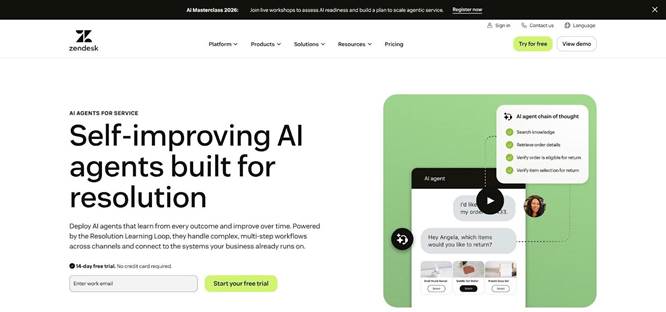
Zendesk AI Agents in native Zendesk workspace screenshot
The agent draws on your historical interactions to recognise intent and reply with help-centre content. When a question falls outside its scope, skills-based routing moves the ticket to the right human in seconds and adds a concise summary.
Enterprise leaders value the extras: role-level permissions, built-in CSAT surveys, and analytics that flag gaps in your articles. Pricing is an add-on, so costs rise with volume and you remain within the Zendesk ecosystem. For teams already committed to that stack, the trade-off often saves weeks, sometimes months, of integration work.
3. Google Gemini Enterprise – orchestration muscle for planet-scale support
Most AI platforms teach a bot to chat. Gemini Enterprise prepares a fleet and gives you a command center to keep every agent aligned. Google folded its Vertex AI tools into this workspace in April 2026, so model tuning, agent testing, and DevOps controls now live under one roof.
That consolidation matters because support at scale is rarely about a single bot. You need knowledge sharing, role-based access, and rollback options when experiments misfire. Gemini’s Agent Studio offers a visual builder and governance controls that let supervisors monitor and manage agents securely.
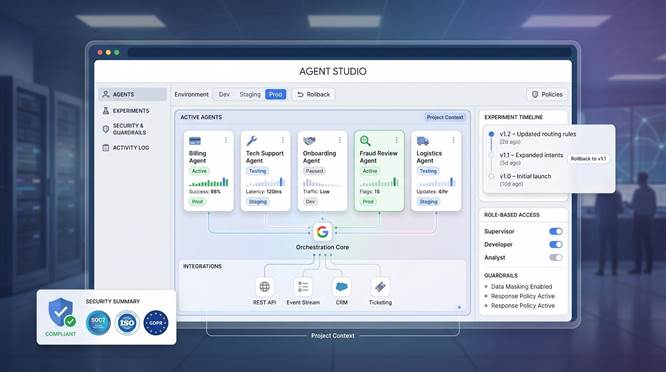
Security meets the usual big-cloud marks (ISO, SOC, FedRAMP Moderate), and context windows fence conversation data to your project. Integrations arrive through REST and event streams, which means deeper plumbing up front but near-limitless extensibility once in place.
The trade-off? You work within Google’s rules. Hosting, pricing, and model governance stay inside the Alphabet ecosystem. If that fits your broader cloud strategy, Gemini Enterprise supplies horsepower few rivals match.
4. Intercom Fin – conversational finesse wrapped in a slick messenger
Intercom built its brand on elegant in-app chat bubbles, and Fin keeps that shine while offloading repetitive Q&A traffic. Train the agent on your help centre and it begins resolving up to 50 percent of inbound chats within days, feeding gaps back into article suggestions so knowledge stays current.
Fin’s key strength is context carry-over. A user who moves from web to mobile meets the same agent with the same memory, so they never repeat themselves. When a human steps in, Fin supplies a concise summary and suggested replies that trim seconds off handle time.
Compliance deserves a closer look. Intercom offers region-specific hosting and detailed audit logs, yet on-premises deployment is not available. Pricing is quote-only, and total cost scales with conversation volume rather than seats, which can suit growing teams.
If your product already ships with the Intercom messenger embedded, Fin delivers AI automation without a migration headache.
5. Ada CX – low-code brains that hit enterprise volume
Ada calls itself the “brand interaction layer,” and its intent detection backs that claim. Import your FAQ, policy PDFs, and past chat logs, and within hours the agent routes payments, password resets, and shipping questions without developer help.
The interface is playful: drag-and-drop flows with fallback branches, version control, and multi-language controls in one dashboard. This lets product managers, not just engineers, refine answers as policies change. Behind the scenes, Ada keeps each customer’s data in isolated tenants and maintains SOC 2 compliance, a must for finance and telecom firms under strict audits.
Voice is the newest extension. Through partnerships with Twilio and other providers, Ada pushes the same knowledge to IVR calls, so one brain serves every channel. Pricing is quote-only, and success is measured by deflection rate rather than seats, aligning cost with business impact.
If you want fast iteration without code and need one AI to cover chat, social, and voice, Ada merits a closer look.
6. Freshworks Freddy AI Agent Studio – no-code builders for instant scale
Freddy began as a smart helper inside Freshdesk. In 2026 it grew into a full Agent Studio where you drag, drop, and deploy end-to-end workflows without writing code. The agent can reply to a return request, trigger a Shopify refund, ping FedEx for tracking, and update ticket status from one canvas.
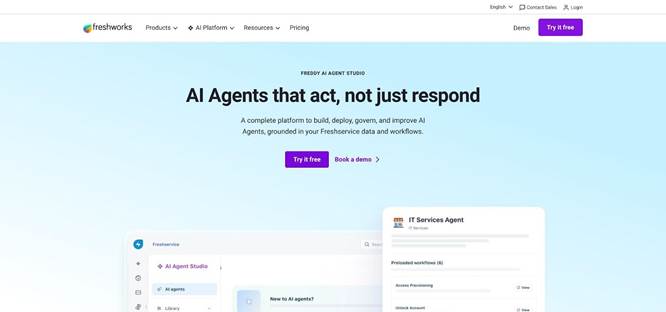
Freshworks Freddy AI Agent Studio no-code workflow canvas screenshot
The new Command Center gives managers a single view to watch automations in real time. You can spot bottlenecks, pause misbehaving agents, and roll back changes before customers notice. That oversight appeals to enterprise operations teams that value governance as much as clever chat.
Freddy lives natively in Freshdesk and Freshchat, so channel hand-offs and SLA rules flow into each playbook. Pricing is tiered: core AI features land in the Pro plan, while Agent Studio resides at the Enterprise level with dedicated support included.
For companies already invested in the Freshworks suite, Freddy delivers extensive automation at the pace of a weekend build.
7. Salesforce Einstein Service AI Agents – support that speaks fluent CRM
If your customer data already lives in Service Cloud, Einstein is the agent who knows your accounts better than some teammates. It reads every case note, purchase record, and marketing touch to personalise replies in real time, then logs each outcome so your dashboards stay fully accurate.
Einstein bots use natural language to triage, solve, or escalate issues across chat, SMS, and WhatsApp. When a hand-off is needed, the agent adds a concise summary and next steps directly inside the case, trimming minutes from handle time. Supervisors gain coaching insights as well, thanks to AI-scored conversation quality that flags tone slips or policy misses.
Security covers the enterprise basics (SOC 2, GDPR) with optional Hyperforce regional hosting if data residency is critical. Pricing follows a conversation-based model bundled into Service Cloud editions, so budget aligns with case volume.
For teams already deep in the Salesforce ecosystem, Einstein adds AI automation to existing workflows with almost zero integration lift.
8. PolyAI voice assistants – natural conversations on the phone line
Phone support still accounts for a large share of enterprise interactions, and PolyAI focuses on that channel with voice agents that sound human, answer in under one second, and handle complex dialogue in more than seventy-five languages.
PolyAI fits into existing call flows. Point the assistant at your IVR entry, map intents from real transcripts, and let callers speak freely. A live agent steps in only when sentiment drops or authentication fails, which shortens wait times and leaves specialists for tougher cases.
Security remains strict: calls move through encrypted SIP trunks, and audio does not train a shared model. Each reply carries a confidence score that flags risk. Pricing combines a platform fee with per-minute usage, so cost tracks with call volume instead of seat count.
For teams that still field heavy phone traffic, PolyAI supplies a multilingual first responder that answers every call.
9. LivePerson Conversational Cloud – AI with a human safety net
LivePerson brings more than twenty-five years of messaging data to its AI, and it shows. The Conversational Cloud trains agents on industry-specific intents and layers sentiment analysis to decide when empathy beats automation. The result is a mix of bots and humans that keeps CSAT above 90 percent for major telecom and banking clients.
Setup starts with a data audit. LivePerson ingests past chats, tags intents, and highlights knowledge gaps before the first bot responds, so you avoid launching an under-trained agent. After rollout, supervisors watch confidence scores in real time and can join any conversation with one click, keeping the safety net close.
Security remains tight. The platform supports PCI-DSS for payments, automatically redacts card numbers, and offers regional hosting in North America, Europe, and APAC. Pricing blends a platform fee with usage tiers based on resolved interactions, giving enterprises room to experiment without signing a blank cheque.
If your brand promises high-touch care but ticket volumes keep climbing, LivePerson lets AI handle routine queries while humans deliver the finishing touch.
10. Ultimate (Zendesk Advanced AI) – multilingual automation built for service desks
Ultimate began by resolving tickets for European e-commerce brands, so multilingual skill sits at its core. The platform detects language, routes the customer to a matching model, and serves answers in more than one hundred languages without asking you to duplicate flows for every locale.
Since its acquisition by Zendesk, Ultimate’s technology now fuels Zendesk’s advanced AI agents. The engine is embedded inside Zendesk, so the agent reads internal macros, SLAs, and custom fields just like a human rep. When a question falls outside the knowledge base, the AI turns the chat into a completed ticket and sends it to the correct queue, so nothing is lost.
Security meets enterprise standards: ISO 27001, GDPR, and SOC 2, with EU or US data residency at signup. Pricing arrives as an add-on to Zendesk Suite and scales with your help desk contract.
For brands that serve multiple regions and already rely on Zendesk, Ultimate provides linguistic flexibility with enterprise discipline.
11. Twig – overlay AI that proves its worth in hard numbers
Twig positions itself as a precision tool for support automation. Instead of replacing your help desk, it layers on top, reads every article, ticket, and release note, and answers questions with source citations included. That transparency helps when leaders want proof, not promises.
Twig cuts customer support response times by up to 60 percent and automates more than half of incoming tickets using AI trained on your data. While many platforms tout deflection, few provide live statistics that translate so directly into lower costs and faster resolutions.
Implementation stays light. A JavaScript snippet drops into your web app, and an API connects Twig to Zendesk or Salesforce so resolved chats still appear in your analytics. Security follows the overlay model too, as the agent processes data without storing it, easing compliance reviews in regulated industries.
Pricing is pay-as-you-go with tiers tied to resolved interactions, ideal for teams testing the waters before scaling to seven-figure volumes. If you need quick wins and board-ready metrics, Twig delivers results you can present with confidence.
12. Twilio Flex plus Agent Connect – build your own AI contact center
Twilio doesn’t supply a ready-made chatbot. Instead, it offers Flex, an embeddable contact-center canvas, and Agent Connect, a set of APIs to add AI to every call, chat, or SMS thread. You pick the model, define orchestration rules, and keep full control of the customer journey.
The new Flex SDK, launched in April 2026, speeds up that work. Developers drop UI components into existing apps so agents stay in the workspace they know. Behind the scenes, Conversation Memory stores context across channels, and Copilot drafts summaries so humans step in fully briefed.
Pricing follows the Twilio pattern: pay for what you use. A base platform fee covers routing and analytics, and usage tiers bill for AI minutes and messages. This à la carte model suits enterprises with seasonal demand or teams that want to pilot automation in one region before scaling.
If your team needs a custom stack without a two-year CCaaS migration, Twilio Flex plus Agent Connect provides the tools to build an AI-first contact center on your timeline.
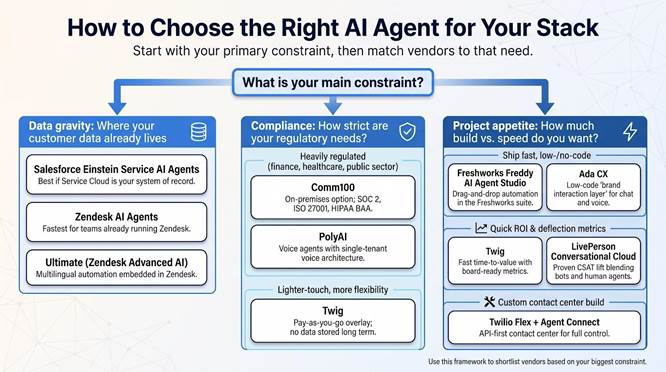
How to choose the right agent for your stack
All twelve platforms solve the same challenge: scaling support without scaling headcount. They approach it in different ways, so the quickest filter is to match each vendor’s strength to your top constraint.
Start with data gravity. If every customer fact already sits in Salesforce or Zendesk, tools such as Einstein or Zendesk AI drop in with almost no integration drag. Need no-code speed? Freshworks Freddy and Ada excel at ship-today builds.
Next, weigh compliance. Heavily regulated teams lean on Comm100’s on-premises option or PolyAI’s single-tenant voice architecture, while lighter-touch industries may trade that control for Twig’s pay-as-you-go model.
Finally, consider project appetite. Choose Twilio Flex only if you have developers ready to craft a custom contact center. If you want quick ROI and meaningful deflection numbers by next quarter, Twig or LivePerson is the safer bet.
Tie your main constraint (platform lock-in, compliance, or build speed) to the matching strength above, and your shortlist drops from twelve tools to two or three in a single meeting.
Wrapping up
AI agents are no longer experimental. They run production queues, cut wait times, and pass strict security audits. The platforms above show there is an option for every stack, whether you want turnkey chat deflection or a custom voice-enabled contact center.
The next frontier is orchestration. Tools such as Google Gemini and Twilio Flex signal multi-agent ecosystems where bots share context and call specialised skills on demand. As these capabilities mature, the line between “chatbot” and “support platform” will fade even more.
For now, the path is clear: match each agent’s greatest strength to your biggest roadblock, pilot quickly, and measure results relentlessly. Done right, you free human experts to solve the problems people handle best while bots keep the lights on 24/7.