


































For a finance company, fintech startup, or business publication, guest posting can introduce expertise to new readers and strengthen a site’s visibility. But the value of a placement depends on more than a publisher’s authority score. The best relevant finance guest posting sites reach an audience that has a reason to care about your subject, publish content in a suitable context, and offer terms that fit your goals. A disciplined selection process helps avoid spending time or budget on placements that look impressive in a spreadsheet but contribute little in practice.
Relevance and authority answer different questions
Authority metrics estimate the strength of a website’s backlink profile or search presence. They can help compare potential publishers, but they are third-party measurements, not guarantees of rankings, referral traffic, or editorial quality. A high score alone does not show whether a site’s readers are interested in your product, whether its finance coverage is current, or whether a guest article will be placed where people can find it.
Relevance is about the relationship between the publication, its audience, and your content. A piece on payment infrastructure may suit a fintech readership, while an article about small-business cash flow may be more useful on a site serving entrepreneurs. A placement with a closer audience fit can support brand credibility and attract more qualified visitors, even when the publisher’s authority score is lower.
These measures work best together. The practical question is not whether relevance or authority matters more in every case, but whether a particular opportunity combines enough of both to justify its cost and effort. A useful comparison of finance guest posting options can help frame that decision around audience, publication, and terms rather than a single metric.
Assess the publication, not just its score
Start by reviewing the site as a reader would. Look at its recent articles, section structure, headlines, and contributor standards. Is finance a regular subject, or does the site publish an occasional finance post among unrelated topics? Do articles offer analysis and practical information, or are they thin pages built mainly to host links? Recent publishing activity matters too: an inactive site may have a recognizable name but little current readership.
Consider the audience each publication appears to serve. Business Insider, Barchart, Finextra, AllBusiness, and Coinpaper, for example, cover different parts of the business and finance landscape. Their names alone do not establish that any one outlet is right for a specific pitch. A market analysis, banking technology explainer, small-business guide, and cryptocurrency article may each need a different readership. Match the subject and level of detail to the publication’s existing coverage.
Where data is available, review estimated organic traffic, the pages that attract visitors, and the geographic or professional audience. Treat such figures as directional rather than definitive. A sitewide traffic estimate cannot tell you whether the relevant section has an engaged audience, and a strong domain metric does not guarantee that your article will receive meaningful visibility.
Check editorial quality and publishing terms
Before committing, clarify how the article will be reviewed and presented. Ask whether editors can revise the draft, what topics and formats they accept, and whether the post will be labeled as contributed content. Confirm the proposed placement, publication timeline, expected permanence, and any restrictions on links. Make sure the publisher’s terms align with your organization’s policies and applicable advertising or disclosure requirements.
Editorial standards are important for both readers and long-term reputation. A thoughtful article that answers a genuine question is more useful than copy written around a link. Avoid publishers whose pages are crowded with unrelated promotional posts, whose content lacks clear editing, or whose promises focus on guaranteed ranking outcomes. Search engines and readers can both respond poorly to manipulative publishing patterns, so prioritize useful material and transparent arrangements.
Compare opportunities against a defined goal
Set the purpose of the campaign before comparing prices. If the aim is referral traffic, audience overlap and prominent placement may matter most. If the goal is brand recognition, consider the publication’s reputation and whether its readers are likely to remember the insight. If you are supporting search visibility, evaluate link context and editorial fit without assuming that any individual placement will produce a specific ranking change.
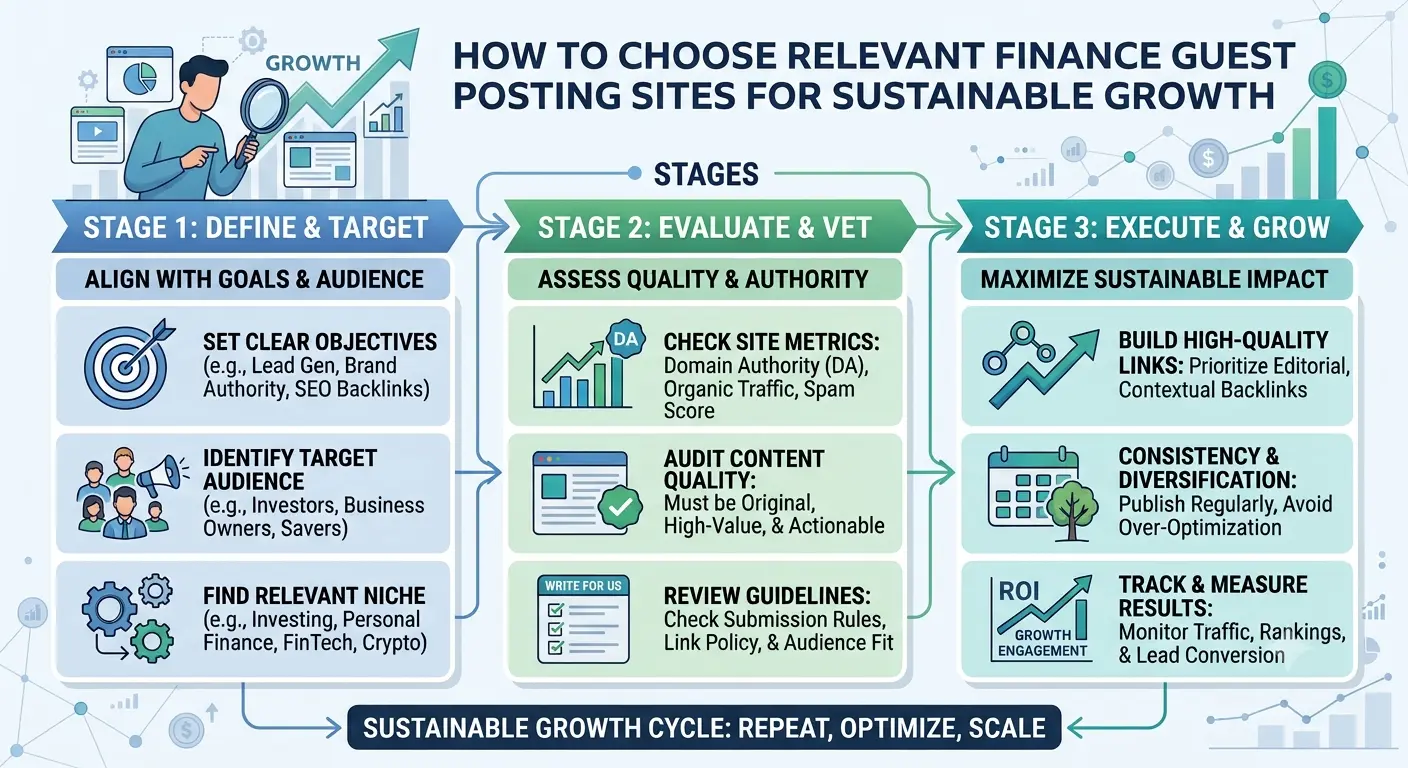
A simple shortlist can score each prospect on several dimensions:
- Topic fit: Does the publication regularly cover the subject, and would its readers benefit from the proposed article?
- Audience fit: Does its readership match the customers, partners, or professionals you want to reach?
- Quality: Are recent articles informative, edited, and clearly organized?
- Authority and visibility: Do available metrics and relevant page-level evidence support the opportunity?
- Terms and cost: Are the process, placement, timeline, and price clear and reasonable?
Use the list to compare trade-offs rather than produce a rigid ranking. A smaller specialist publication may be a better choice for a narrowly defined audience, while a larger business outlet may offer broader exposure. The right balance depends on what the campaign needs to accomplish.
Make outreach manageable without diluting quality
Researching publications, tracking responses, editing drafts, and coordinating deadlines can consume time that a lean marketing team needs elsewhere. Some businesses delegate parts of this work, such as prospect research or copyediting, while keeping editorial decisions and final approval in-house. When planning that support, consider whether US virtual assistants are more expensive than other options, and compare rates with the complexity and oversight required. Osdire, for instance, is a freelance marketplace where buyers can hire for tasks across writing, research, marketing, and technology; a clear brief and review process remain essential whichever provider you choose.
Guest posting works best as one part of a broader publishing strategy, not as a shortcut around useful content. Choose publications by combining topical fit, audience, editorial quality, authority signals, and transparent terms. That approach can lead to better-informed decisions, more relevant readership, and a campaign whose costs are tied to a clear business purpose.