
































The Cybersecurity Challenge of Connected Industry
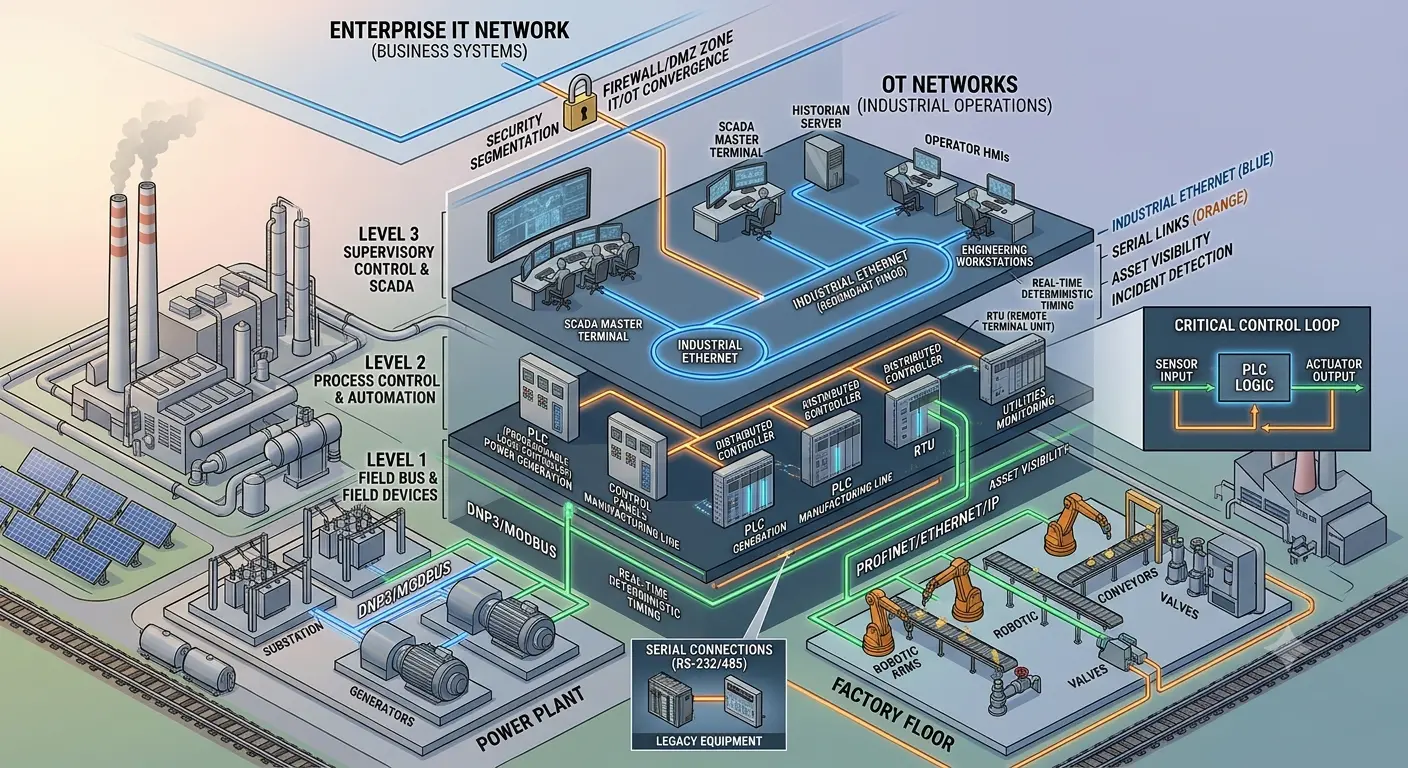
Industry 4.0 connects industrial equipment, sensors, control systems, and business platforms to support real-time monitoring and data-driven decisions. This relies heavily on operational technology (OT), including programmable logic controllers (PLCs), supervisory control and data acquisition (SCADA) systems, and industrial control systems (ICS). However, a significant security challenge emerges when traditionally isolated production environments exchange data with corporate IT networks, cloud platforms, and remote services. To mitigate these risks, organizations need a robust OT cybersecurity solution that protects critical industrial operations while preserving essential data flows and maintaining strict system availability.
1. Why Industry 4.0 Creates New OT Security Risks
IT/OT convergence significantly expands the number of connections between industrial environments and external systems. This integration introduces common risks, including exposed remote access, outdated legacy equipment, insecure industrial protocols, network misconfigurations, and compromised third-party connections. Consequently, a cyberattack on an industrial network can severely affect production continuity, equipment reliability, product quality, and even worker safety. Because industrial environments prioritize physical uptime, traditional IT security approaches often require careful adaptation to account for the strict performance, availability, and safety requirements of these settings. Ultimately, effective OT cybersecurity must go beyond protecting digital information; it must actively safeguard the physical processes and machinery that drive modern manufacturing and infrastructure.
2. Why Traditional Network Defences May Not Be Enough
Firewalls, access controls, intrusion detection, and network segmentation play a vital role in reducing cyber risks. However, these software-based controls heavily depend on correct configuration, continuous maintenance, and the enforcement of appropriate security policies. Furthermore, bidirectional network connections can inadvertently create potential pathways for unwanted traffic or malware to reach sensitive industrial systems. To address this, hardware-enforced network separation serves as an additional, robust safeguard for high-risk environments. It is important to clarify that this hardware-grade protection complements, rather than automatically replaces, essential security layers like firewalls, continuous monitoring, strict authentication, and incident response protocols.
3. What Is Hardware-Grade OT Cybersecurity?
Hardware-grade protection is defined as security enforced by physical mechanisms rather than relying exclusively on software configuration. Technologies like unidirectional gateways and data diodes are prime examples, designed to physically enforce one-way data transfer. This approach allows critical operational information to leave a protected OT network without creating a corresponding inbound communication path. Potential applications include industrial monitoring, historian replication, security operations centre (SOC) visibility, and automated reporting. However, the specific level of protection ultimately depends on the complete network architecture, proper implementation, and the careful treatment of data on both sides of the security boundary.
4. How Data Diodes Help Protect Industrial Networks
A data diode is a specialized security device designed to allow data to travel in one direction only. Unlike logical restrictions configured in software, which can be bypassed or misconfigured, physical directionality is strictly enforced by the hardware itself. For example, a manufacturing facility might send production metrics, system alarms, and historian data to a corporate analytics platform while physically preventing any return traffic through that same connection. In high-risk industrial environments, organizations may secure with a data diode to transfer operational information while maintaining a strong separation between trusted control systems and less-trusted networks. This greatly reduces inbound attack paths without losing access to useful production data. Nevertheless, data diodes do not independently guarantee the safety of the transferred content or eliminate every cybersecurity risk.
5. Key Industries That Can Benefit from Hardware-Enforced Protection
Several key sectors benefit significantly from hardware-enforced protection. In Manufacturing and Automotive, it protects production lines, industrial robots, PLCs, and manufacturing execution systems while supporting operational reporting. For Energy and Critical Infrastructure, it helps isolate sensitive control environments while safely transferring monitoring information to external systems. In Pharmaceuticals and Chemicals, it protects process control environments where operational disruption, quality issues, or unsafe conditions can have severe consequences. Similarly, in Water and Utilities, it supports controlled information flows from remote monitoring and control environments to central operational teams. Ultimately, deployment decisions should carefully reflect each sector’s specific risk profile, operational requirements, and applicable regulatory standards.
6. How to Build a Strong OT Security Strategy
Building a strong OT security strategy requires a comprehensive approach. First, map assets and connections to identify critical equipment, network zones, communication paths, and external dependencies. Next, segment industrial networks to separate control systems from corporate IT and other less-trusted environments. Restrict data flows by allowing only necessary communications and considering unidirectional transfer where appropriate. Strengthen access management by using individual accounts, least-privilege access, and controlled remote access. Continuously monitor industrial activity to detect unusual traffic and maintain visibility into important systems. Finally, plan for recovery by testing incident response, backups, isolation procedures, and operational continuity plans. Throughout this process, emphasize that security controls must be implemented without compromising industrial safety or essential operations.
Protecting Industrial Progress Without Sacrificing Connectivity
As Industry 4.0 expands, securing connected industrial systems is more critical than ever. Combining network segmentation, continuous monitoring, strict access controls, and hardware-enforced one-way communication provides a robust defense. A carefully designed OT security architecture helps organizations share vital operational data while significantly reducing exposure to external threats. Industrial operators should proactively assess their network architecture and select protection measures based on their unique operational risks.