






























Barely a quarter of vulnerabilities listed in CISA’s Known Exploited Vulnerabilities catalog were fully fixed in 2025, a drop from 38% the prior year, and the typical fix took well over a month to complete.
Those numbers are not a technology gap, they are a workflow gap. Most SOCs treat patching as something that happens somewhere else, handled by a separate IT team working from a different queue with different priorities. Here is what changes when patch management gets built directly into the security operations workflow instead of sitting next to it, and why that shift shows up in the numbers as clearly as it does in day to day operations.
Key Takeaways
- Barely a quarter of CISA KEV catalog vulnerabilities reached full closure in 2025, and the average remediation dragged on for more than six weeks, based on figures reported in Verizon’s Data Breach Investigations Report.
- Patch management works best when it is treated as a SOC function with defined SLAs, not a separate IT chore disconnected from detection and response.
- Not every vulnerability deserves the same remediation timeline, and risk based prioritization matters more than patching everything as fast as possible.
- Integrating patch status into SIEM and SOAR platforms gives analysts the same visibility into remediation that they already have into alerts and incidents.
- Measuring remediation by category, rather than as a single aggregate number, reveals where a workflow is actually breaking down.
Why Patch Management Belongs Inside the SOC Workflow, Not Beside It
Vulnerability data usually lives in one tool, ticket assignment in another, and confirmation of an actual fix in a third system nobody on the security team has direct visibility into. That fragmentation is exactly why remediation numbers stay low even at organisations with mature detection capabilities.
Bringing a capable patch management solution for security teams directly into the SOC toolchain closes that visibility gap. Analysts who already triage alerts and manage incident tickets can see patch status in the same place, rather than filing a request into IT’s separate system and hoping it gets prioritised correctly.
This is not simply a nice to have integration. A SOC that can correlate an active alert with an unpatched, exploitable vulnerability on the same asset gains context that neither system provides on its own, turning two disconnected data points into a single, actionable risk signal.
The alternative, keeping vulnerability data and alert data in separate silos, means analysts routinely investigate suspicious activity on a host without ever knowing that host was already flagged as carrying a known, exploitable weakness.
Where Patching Fits in the Vulnerability Management Lifecycle
Patch management is one stage within a larger, continuous cycle, not a standalone task.
| Stage | What Happens | SOC Involvement |
| Discovery | Vulnerability scanning identifies exposed assets | Feeds directly into SIEM asset inventory |
| Prioritization | Risk scoring based on exploitability and exposure | Analysts cross reference threat intel |
| Remediation | Patch tested and deployed | Tracked against defined SLA per risk tier |
| Verification | Confirm the fix closed the exposure | Rescanned and logged as part of case closure |
Treating verification as a SOC responsibility, not just an IT checkbox, is what actually closes the loop between a patch being deployed and a vulnerability being confirmed gone.
Prioritization: Not Every Vulnerability Deserves the Same SLA
Patching everything on the same aggressive timeline is unrealistic, and patching everything on the same relaxed timeline is dangerous. Both extremes waste effort, one by burning out a team chasing low risk issues, the other by leaving genuinely dangerous exposures sitting untouched for weeks.
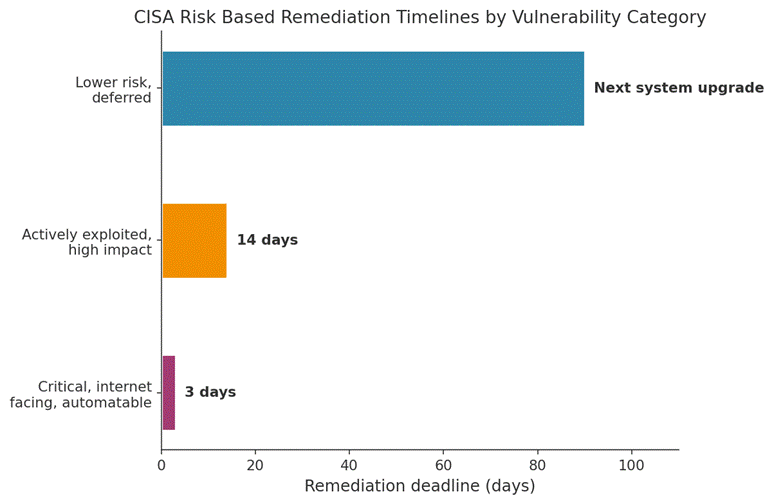
Chart: CISA’s risk based remediation deadlines by vulnerability category, under BOD 26-04.
Reviewing
CISA’s newest risk based remediation timelines shows how a tiered approach, rather than a single blanket SLA, actually reflects how differently urgent various vulnerabilities are. A vulnerability that is internet facing, actively exploited, and grants full system control simply cannot sit in the same queue as a low severity issue on an isolated internal system.
Reviewing
Practical patch management strategies for security teams reinforces the same point from an operational angle, since prioritization frameworks only work if the SOC actually has the process discipline to follow them consistently, week after week, not just during the initial rollout.
Integrating Patch Management With SIEM and SOAR
Patch status becomes far more useful once it lives inside the same tools analysts already use every day. A remediation deadline tracked only in a spreadsheet or a separate IT ticketing system is a deadline that competes for attention against every other tool a security team already has open.
| Key Principle: A vulnerability without a tracked remediation deadline is a vulnerability that will eventually get forgotten. Integrating patch status into existing dashboards turns an easy to lose sight of a task into a visible, measurable one. |
Understanding
How SOAR platforms coordinate automated response actions helps clarify why patch management fits naturally into that same automation layer, since triggering a remediation workflow is not conceptually different from triggering an incident response playbook. Reviewing
How SIEM platforms fit into daily SOC operations shows where patch status data can realistically be surfaced without requiring analysts to learn an entirely separate system just to check on remediation progress.
Building the Workflow: A Practical Model
Moving from ad hoc patching to an integrated SOC workflow usually follows a similar pattern, even across organisations with very different tooling and team sizes.
| What Matters | Ad Hoc Patching | Integrated SOC Workflow |
| Ownership | Split between IT and security, unclear | Defined, with SOC visibility throughout |
| Prioritization | Often first in, first out | Risk based, tied to exploitability and exposure |
| Tracking | Separate ticketing system | Surfaced in SIEM or SOAR dashboards |
| Verification | Assumed once deployed | Rescanned and confirmed before case closure |
| Reporting | Manual, inconsistent | Automated, tied to defined SLAs |
Reviewing lessons on
Balancing patch deployment against system performance is a useful reminder that speed and stability are not opposing goals, since a rushed patch that breaks a production system creates a different kind of incident entirely, one that can consume just as much analyst time as the vulnerability it was meant to fix.
Measuring Success: Metrics That Matter
Aggregate patch counts hide more than they reveal about whether a workflow is actually working, since a high count of patches applied says nothing about how many of those fixes were actually confirmed.
“Organisations fully remediated just 26% of vulnerabilities in CISA’s Known Exploited Vulnerabilities catalog in 2025, with a median resolution time of 43 days, according to Verizon’s Data Breach Investigations Report.”
That gap between patches applied and vulnerabilities fully closed is exactly what a SOC integrated workflow is designed to catch. Reviewing
MITRE aligned threat hunting playbooks alongside patch verification data can also surface cases where an unpatched vulnerability was actively probed before remediation completed, turning a routine patching metric into genuine threat intelligence. A patch that finally lands after weeks of exposure is not automatically a success story if the asset was already touched during that window.
Common Pitfalls When Integrating Patch Management Into SOC Workflows
A handful of avoidable mistakes show up repeatedly when organisations attempt this integration, often the same ones regardless of team size or industry.
| Warning: Never treat a deployed patch as equivalent to a closed vulnerability. Rescanning and confirming remediation is the step most workflows skip, and it is exactly the step that determines whether the fix actually worked. |
- Assigning every vulnerability the same remediation deadline regardless of risk
- Tracking patch deployment without tracking verification separately
- Keeping patch data in a system the SOC cannot see without switching tools
- Treating remediation as complete the moment a ticket is closed, rather than confirmed
FAQs
Should patch management be owned by IT or by the SOC?
Ownership varies by organisation, but visibility should not. Even when IT executes the actual patching, the SOC benefits from seeing remediation status alongside other security telemetry rather than in a separate, disconnected system, since that visibility is what makes correlation with active threats possible in the first place.
How should remediation SLAs be set?
Risk based tiers, factoring exploitability, exposure, and potential impact, work better than a single blanket deadline for every vulnerability, since treating every issue as equally urgent tends to slow down the truly critical ones and burn analyst time on issues that could safely wait.
What is the difference between patch deployment and remediation verification?
Deployment means the patch was installed. Verification means a rescan or equivalent check confirming the underlying vulnerability is actually gone, a distinction many workflows blur together incorrectly, treating a closed ticket as proof of a closed exposure when the two are not the same thing.
Can patch management be automated within a SOAR platform?
Largely yes, particularly triggering, tracking, and escalating remediation tasks based on risk tier, though the actual patch testing and deployment still benefit from human oversight before wide rollout, especially for systems where an unexpected compatibility issue would cause real operational disruption.
Why does the CISA KEV remediation rate matter for organisations outside the federal government?
The KEV catalog reflects vulnerabilities under active, real world exploitation, so the same urgency logic applies regardless of sector, even though the compliance deadlines themselves are specific to federal agencies. A vulnerability being actively exploited elsewhere is a meaningful risk signal no matter who is required to act on it.
Conclusion
Patch management stops being an afterthought once it lives inside the same workflow, tools, and metrics the rest of the SOC already relies on. The gap between vulnerabilities patched and vulnerabilities actually verified closed is where most organisations are losing ground, not in detection or initial response. Building remediation into the SOC workflow, with risk based prioritization and real verification, closes that gap in a way a disconnected, IT only process consistently fails to, and it does so using the same discipline analysts already apply to every other part of the job.
References
CISA, BOD 26-04: Prioritizing Security Updates Based on Risk — https://www.cisa.gov/news-events/directives/bod-26-04-prioritizing-security-updates-based-risk
Fortinet, What Is SOAR? Security Orchestration, Automation, and Response — https://www.fortinet.com/resources/cyberglossary/what-is-soar
Fact Check: All statistics and data points in this article were verified against original sources as of 20 August 2026. Sources are listed in the References section.