



























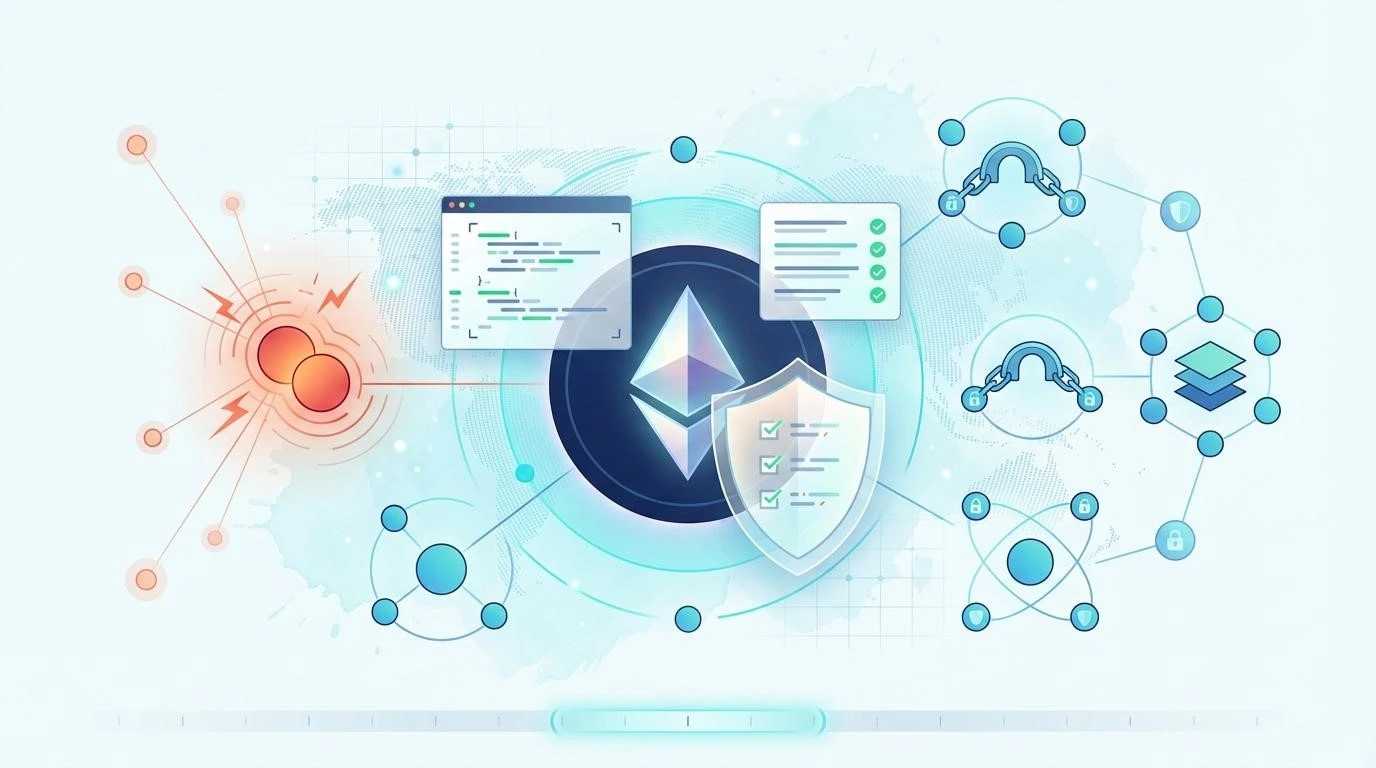
Attackers siphoned $3.35 billion in 630 Web3 hacks during 2025—many through Ethereum contracts. (GlobeNewswire)
Because on-chain code is immutable, prevention beats cleanup. A smart-contract audit puts seasoned eyes on your codebase before launch, catching logic flaws, oracle traps, and cryptographic cracks ahead of attackers.
Investors, exchanges, and regulators increasingly require a formal audit before listing tokens or opening liquidity doors.
This guide shows you how to choose the right Ethereum smart-contract auditor by comparing six leading security firms and pinpointing when each one excels.
The 2025–2026 threat outlook
Fewer hacks, bigger headlines
Hackers strike less often, yet each incident grabs front-page space.
In 2025, recorded hacks dipped slightly from 2024, but total losses surged to $3.35 billion across 630 cases. Instead of a single NFT mint gone wrong, we now see one exploit draining nine-figure treasuries in seconds.
Large, well-funded protocols are attractive targets because they pool massive TVL and plug into dozens of downstream projects. A single bridge failure now freezes liquidity throughout an entire DeFi stack, rattling users who never touched the original code.
For founders like you, that shift changes the math. Low-probability, high-impact events are no longer fringe scenarios; they define the baseline risk. A cursory static scan cannot keep pace. We need deeper reviews that stress-test economic design, cross-chain assumptions, and upgrade paths before mainnet.
Attackers already treat every launch as a bounty hunt. Our audits must do the same, on our timeline, not theirs.
New attack vectors in focus
Bridges, rollups, and governance modules now stretch beyond plain Solidity; each layer introduces new components and fresh failure modes.

Cross-chain bridges juggle relayers, light-client proofs, and multi-sig custodians. If any link slips, funds can disappear across every chain connected to that bridge. One mis-configured validator set has already wiped out liquidity pools that never touched the original contract.
Layer-2 rollups pose a different puzzle. Fraud proofs, batch challengers, and data-availability committees live outside your core dApp repo, yet a bug in any of them lets attackers forge withdrawals or shuffle history. Auditors now read as much Rust and Golang as Solidity to trace those paths.
Even familiar governance has grown sharper teeth. Flash-loan whales can borrow voting power, pass a malicious proposal, and drain treasuries before the snapshot closes. The exploit is fresh, but the remedy is classic: inspect economic design, not just syntax.
Assume every integration point is an entryway. Modern audits therefore map cross-chain message flows, simulate delayed governor upgrades, and review rollup contracts alongside their off-chain proof logic. Security today concerns whole systems, not isolated snippets.
Quantum computing shifts from sci-fi to sprint plan
Quantum computers once felt like distant speculation. Ethereum co-founder Vitalik Buterin now pegs the odds of current cryptography failing by 2030 at roughly 20 percent.
That possibility changes priorities. If your protocol must safeguard value for a decade or more, you cannot ignore post-quantum defenses. Attackers can capture encrypted traffic today and decrypt it later when hardware matures—a “hack now, crack later” playbook.
Audit scopes therefore stretch beyond Solidity linting. Reviewers ask, “Which signature scheme protects these admin keys, and how quickly can we migrate to a lattice-based option?” Firms such as Project 11—profiled later in this guide as Project Eleven—already embed quantum-threat models inside their audits and map clear upgrade paths.
In a December 2025 collaboration with the Solana Foundation, Project 11 assessed validator and wallet exposure then spun up a testnet secured by post-quantum digital signatures, proving that end-to-end quantum-resistant transactions are practical and scalable citeturn3view0.
Ethereum teams now treat that playbook as the reference blueprint for migrating admin keys before Q-Day.
Treat quantum readiness like test coverage: an upfront cost that avoids existential pain later.
Auditors level up with AI and crowdsourced firepower
Security teams once trusted static analyzers and intuition. Today they layer machine learning models, symbolic execution engines, and public contests to broaden coverage.
Consider QuillAudits. Its QuillShield agent parses each Solidity build, flags risky patterns, and explains the threat in plain English. Because the software runs continuously, reviewers focus on complex logic while automation clears routine bugs.
Crowdsourcing flips the model entirely. Platforms such as Code4rena publish your code, set a bounty, and invite hundreds of independent wardens. A recent seven-day contest drew more than 320 researchers; one located an overflow, another crafted an economic exploit, and together they surfaced edge cases an internal team could miss.

The takeaway is straightforward. AI widens the lens, humans make final calls. A blended approach uncovers more issues, faster, and hands you actionable fixes before launch day.
Compliance stops being optional
Regulators no longer watch from the sidelines. The EU’s Markets in Crypto-Assets (MiCA) framework came into force in December 2024, requiring issuers to show “operational resilience” before passporting services. In the United States, the SEC now treats missing audit reports as a disclosure failure, signaling that formal security assessments may soon sit alongside financial statements.
That shift rewrites your launch checklist. An audit is more than a trust badge for users; it is paperwork a future examiner will request. Leading firms already adjust: Trail of Bits maps findings to ISO-27001 controls, and CertiK issues attestation letters that exchanges can upload to compliance portals.

If you plan to list on a regulated venue or attract institutional LPs, collect those artifacts early. Adding them after mainnet is like installing airbags after a collision—costly and sometimes impossible.
Vendor selection criteria and methodology
How we picked the top six
Crypto Twitter pushes out “best auditors” threads daily, yet most recycle the same names without context. We took a grounded route.
We cataloged more than 50 firms that audit Ethereum or other EVM projects, then scored each one against six pillars that matter to founders and regulators: real-world track record, service depth, tooling sophistication, niche expertise, community trust, and pricing accessibility.
Track record shows whether a firm has guarded large TVL during live exploits. Tooling depth reveals how much of the review moves past human eyesight. Niche expertise matters because a zk-rollup demands different skills than an NFT drop. Community trust—visible in public reports and social sentiment—protects your reputation as much as your code. Finally, we compared quotes and lead times so the list serves both lean startups and billion-dollar treasuries.
Only six firms excelled across every pillar. They are not ranked; each thrives in a distinct situation. Together they outline what best-in-class smart-contract security looks like in 2026.
Project Eleven: future-proof assurance
Project Eleven is the new kid everyone in cryptography is suddenly discussing.
While most auditors fixate on today’s exploits, this team starts with a bigger question: What happens when quantum computers break ECDSA? Their reports read like a time-traveler’s guide. They flag the usual reentrancy bugs and, building on their August 2025 study on ethereum quantum attack vectors, map how Shor’s algorithm could expose your admin keys five years out.
The firm formed in the mid-2020s when a group of post-quantum researchers left academia, raised a Series A, and set out to harden blockchains for the long haul. Early work included a full quantum-threat review for Solana and a prototype testnet using lattice-based signatures. Those case studies built credibility fast, proving the team can turn white-paper theory into merged pull requests.
For Ethereum builders, the value is straightforward. You receive a classic smart-contract audit plus a cryptographic stress test that shows whether your upgrade keys, multisigs, and cold-storage wallets can survive a quantum shift. If longevity matters to you, or to your institutional investors, Project Eleven offers protection no one else matches.
The trade-off is maturity. The firm does not yet publish hundreds of reports, and lead times can stretch because demand beats headcount. Many teams pair Project Eleven with a high-volume auditor for immediate coverage, then lean on Eleven’s niche skill set for the pieces that must endure for decades.
Trail of Bits: the surgeon for complex code
Trail of Bits feels less like a traditional auditor and more like a surgical strike team. When your codebase spans Solidity, Rust, and bespoke cryptography, founders often say, “Call ToB.”
The company first secured defense and fintech systems long before DeFi existed, and that heritage shows. Audits start with a design review that challenges every assumption in your white paper, then move into threat modeling that traces how an attacker might pivot from a compromised node to your governance contract.
Tools you already use, including Slither for static analysis and Manticore for symbolic execution, came from this very team. As a result, ToB arrives with software tuned to reveal race conditions, precision loss, and consensus edge cases most scanners overlook.
Expect a rigorous engagement. Engineers write detailed proofs, craft exploit scripts, and review mitigation patches until they are satisfied the attack surface has closed. Turnaround is slower and invoices higher than those of high-volume shops, yet the outcomes speak for themselves. When billions sit behind your contracts or you ship cryptography that still needs battle testing, Trail of Bits offers the confidence that every complex corner received expert scrutiny.
CertiK: scale, dashboards, and brand power
When you need an audit yesterday and a recognizable badge tomorrow, CertiK is often the first call.
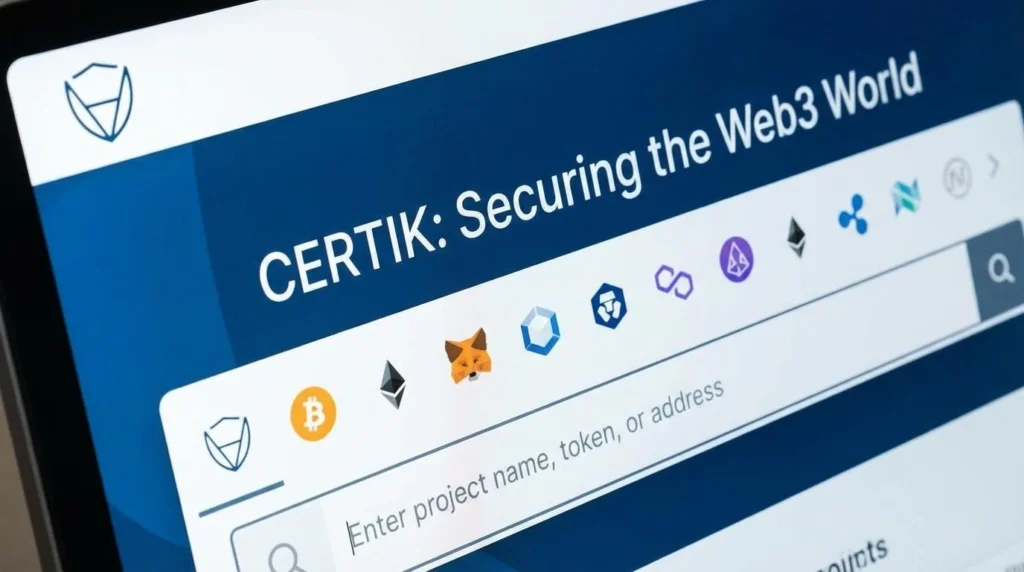
CertiK Blockchain Security Audit and Skynet Dashboard Homepage Screenshot
The firm runs like a production line. Automated scanners process your Solidity, AI models flag risky patterns, and a large bench of reviewers verifies each hit. This hybrid approach lets CertiK publish more than 1,300 audit reports a year while still catching critical flaws, a helpful mix for launchpads and exchanges with tight calendars.
CertiK’s standout add-on is Skynet, a live-monitoring dashboard that watches your contracts after deployment. It alerts you when ownership roles shift, liquidity spikes, or unusual calldata touches the chain. Investors appreciate the real-time transparency, and regulators value the documented alert log.
Some critics say breadth can reduce depth. The answer lies in scoping. For a straightforward DeFi pool or NFT mint, CertiK’s process usually suffices and finishes quickly. If your protocol relies on novel math or cross-chain logic, pair their audit with a boutique specialist for deeper assurance.
Either way, few logos in crypto signal “we did our homework” to mainstream users as effectively as the blue CertiK badge on a landing page.
Halborn: full-stack guardianship
Halborn steps in when your attack surface reaches beyond the chain. Think smart contracts, cloud servers, mobile wallets, Web2 APIs, and employee chat tools.
Its ethical-hacker team treats audits like red-team operations. They inspect AWS roles, simulate phishing, and craft exploits that connect on-chain bugs with off-chain pivots. The approach proved valuable in 2023, when Halborn quietly disclosed the “Rab13s” flaw that threatened more than 200 proof-of-work networks.
For an Ethereum dApp, the appeal is breadth. You receive a Solidity deep dive, penetration testing of the front end, and threat modeling for the infrastructure that signs deployment transactions. After launch, Halborn can run periodic social-engineering drills to keep your team alert.
Pricing mirrors the scope, and the calendar books months in advance. Yet if your protocol manages deposits, real-world identity, or regulated assets, Halborn’s 360-degree coverage often costs less than hiring three separate vendors.
Code4rena: auditing by public contest
Code4rena turns the closed-door audit into a public contest. Instead of hiring a small team, you post your code, fund a prize pool, and invite hundreds of independent wardens.
The incentive structure matters. Wardens earn only when they find a valid bug, so every line receives focused scrutiny. A recent seven-day contest drew 320 researchers and uncovered 36 unique vulnerabilities, including a gas-heavy loop and an oracle-manipulation path.
Speed is another perk. Need eyes on a hot-fix branch next week? Launch a contest on Monday, ship the consolidated findings by Friday, and deploy patched contracts on Sunday. The process is transparent by default; final reports list each issue and its finder, which builds user confidence and satisfies open-source purists.
Trade-offs remain. Coverage is probabilistic; the crowd chases what interests them, so obscure edge cases may slip through. Findings also become public, so you must feel comfortable sharing the details. Many teams run a short private audit first to catch show-stoppers, then open a Code4rena contest to mop up the rest.
Used wisely, the platform delivers wide coverage at a flexible price, making professional-grade security accessible even to projects bootstrapping from a hackathon grant.
Quantstamp: veteran versatility across chains
Quantstamp has weathered every hype cycle since the 2017 ICO boom, and that experience shows.
Its auditors have parsed Solidity, Rust, Move, and even custom virtual machines for more than 1,100 projects. They reviewed early Ethereum 2.0 clients, stress-tested OpenSea’s marketplace logic, and still examine fresh ecosystems like Aptos. That range makes Quantstamp a safe choice when your codebase spans several languages or chains.
Methodologically, the team blends traditional line-by-line review with formal verification whenever the math calls for proof. Need to confirm that a staking contract never mints more than 21 million tokens? They will model the invariant and return a theorem-prover log detailed enough for the toughest auditors.
Turnaround falls in the middle of the pack, faster than a boutique cryptography lab yet slower than a high-volume shop. The deliverables compensate with polish: clear reproduction steps, proposed patches, and links to passing formal proofs when relevant.
If your roadmap includes cross-chain expansions or novel consensus tweaks, Quantstamp’s multi-disciplinary bench spares you the headache of juggling multiple auditors. The fee reflects that depth, but many founders view it as insurance against the complexity of running on four chains at once.
Compare the vendors at a glance
We just covered a lot of ground. To help you scan the field in one bite, we distilled the essentials into a single table. Use it as a quick filter before you dive back into the detailed profiles, or book discovery calls.
| Vendor | Founded | Core strength | Approx. audits | Chains covered | Stand-out offering | Ideal for |
| Project Eleven | 2023 | Post-quantum security | 40 and growing | Ethereum, Solana | Quantum-threat assessment | Long-horizon protocols, novel cryptography |
| Trail of Bits | 2012 | Complex, multi-language code | 120 high-impact reviews | Ethereum, L2s, custom chains | Slither and Manticore tooling | Layer-1s, bridges, exotic math |
| CertiK | 2018 | High-volume audits plus monitoring | 1,300 securing $260 billion total value locked | EVM and non-EVM | Skynet live dashboard | Launchpads, fast timelines |
| Halborn | 2019 | Full-stack security | 240 mixed scopes | Multi-chain and Web2 | Pen-tests, social-engineering drills | User-facing apps, regulated assets |
| Code4rena | 2021 | Crowdsourced contests | 300 contests | Primarily EVM | Competitive bounty model | Startups, rapid iterations |
| Quantstamp | 2017 | Multi-chain formal rigor | 1,100 projects | 55 ecosystems | Formal-verification proofs | Cross-chain expansions, consensus tweaks |
How to choose the right auditor for your project
Start with self-awareness. Map your contract complexity, launch timeline, and treasury size before you email a vendor. A simple ERC-20 crowdsale may not require Trail of Bits, yet a cross-chain lending market probably does.
Next, match expertise to risk. If post-quantum strength features in your pitch deck, invite Project Eleven to the discovery call. If your front end carries as much attack surface as your Solidity, lean toward Halborn’s full-stack model. For mainstream adoption and marketing optics, the CertiK badge still reassures retail users.
Probe methodology. Ask each firm to walk you through a recent report. Look for clear severity ratings, proof-of-concept exploits, and a retest round after patches. Vague claims of “state of the art tools” raise red flags. You want specifics: static analysis, formal verification, threat modeling, and live on-chain monitoring.
Budget realistically. Professional audits start near ten thousand dollars and rise quickly as lines of code and financial complexity grow. Be cautious of bargain offers that promise a three-day turnaround. Speed is welcome; shortcuts are fatal.
Finally, build layered defense. Even the sharpest auditor will not catch every edge case. Run automated scanners during development, launch a public bug bounty, and keep an emergency pause function ready. Security is a continuum, not a single checkmark.
Your pre-audit checklist
Locking down low-hanging fruit before auditors arrive saves time, money, and pride. Run through this quick self-audit so their first findings are not typos you could have fixed in an afternoon.
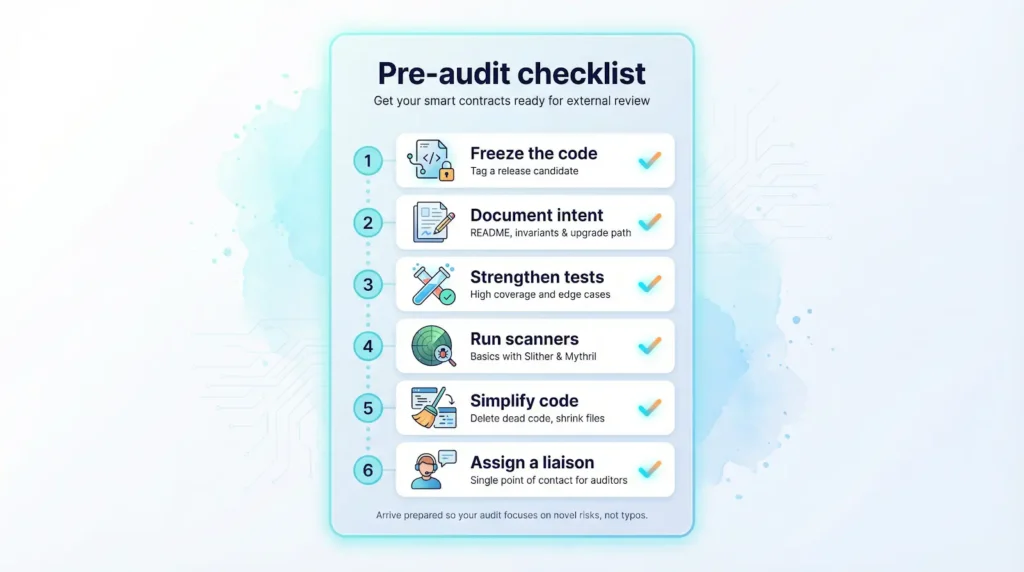
Freeze the code. Tag a release candidate and resist the urge to push “one last tweak”. Auditors need a stable target, not shifting goals.
Document intent. Ship a concise README or spec that explains each contract’s purpose, key invariants, and upgrade path. Clear intent helps reviewers spot deviations faster.
Run your tests, and expand them. Aim for high coverage on core functions and edge-case inputs. When every test passes in CI, you prove basic sanity and let auditors explore deeper logic.
Scan automatically. Tools such as Slither and Mythril catch obvious issues like unchecked arithmetic, reentrancy, and missing events, saving billable hours for human review.
Simplify where possible. Delete dead code, lean on trusted libraries, and break large files into smaller modules. Smaller surface, fewer surprises.
Assign a liaison. Nominate one engineer to answer questions and patch findings during the engagement. Quick feedback loops create cleaner final reports.
Follow this playbook and your external audit shifts from housekeeping to strategic value. You pay experts to test novel logic, not note missing SPDX headers.