

































Cybercrime investigators shut down AnyProxy on May 7, 2025 after the service spent ten years renting hacked home routers to fraud rings. One stray log entry was all agents needed.
This guide is for:
- Security teams tracing malware or phishing from Windows workstations
- Privacy-first power users chasing invisible speed without hype
We judge one thing above all: verifiable no-logs proof—policies, court records, transparency reports, and breach history. You’ll see a quick-scan table, four ranked deep dives, and a Windows hardening checklist so subpoenas never trace back to you.
What “no-logs” means in 2025
A no-logs proxy keeps nothing that can identify what you did or when you did it.
A proxy sees every byte you send, but the operator decides what to store, how long, and who can demand it later. That choice defines your risk.
We group records into three buckets:

- Traffic logs – full URLs, headers, and payloads that reveal your activity.
- Connection logs – your real IP, exit IP, ports, and exact timestamps.
- Account logs – email, payment method, support tickets, and any KYC details.
A true no-logs service discards the first two buckets in real time. The third bucket sticks around for billing or abuse, so we check how much is collected and how it is protected.
Connection metadata needs special care. One IP plus a narrow time window can let courts or ISPs unmask you, even if the content is encrypted. If a provider rotates exit IPs every few seconds but still records timestamps, your cover only lasts as long as its retention window.
Marketing pages rarely spell this out. Lines like “we respect your privacy” or “minimal logging” can still hide weeks of connection data. Our approach: read the policy line by line, verify local data-retention laws, and look for audits or court cases that have tested the claim.
With these definitions set, we can judge every provider’s promise instead of trusting slogans.
Legal and regulatory landscape for logging in 2025
Your exposure starts with geography. Some governments demand logs, while others leave retention to the provider. Check the rulebook before you trust any no-logs claim.
United States – No federal law forces VPN or proxy operators to keep connection data. Any records a company chooses to store can still be subpoenaed or seized with a National Security Letter.
European Union – GDPR Recital 30 treats an IP address plus timestamp as personal data. Providers must declare a purpose and erase promptly; member states can impose targeted orders only under court oversight.
China – The 2017 Cybersecurity Law requires network operators to keep network logs for at least six months and provide them to regulators on request.
India – CERT-In’s directive dated April 28, 2022 obliges VPNs, data centres, cloud, and proxy services to store all logs for 180 days and customer records for five years.
Russia – The Yarovaya amendments compel telecoms to keep full traffic for six months and metadata for three years, accessible to security services without a warrant.
Bosnia and Herzegovina – No statute specifically mandates connection-log retention for VPNs or proxies; operators follow general telecom rules, making the jurisdiction attractive to privacy-focused services.
Take-away: A zero-logs promise is only as strong as the local law behind it. Always ask which government can override the policy.
How we selected and tested the four no-log proxies
Choosing a proxy is like hiring a bodyguard for your traffic, so our vetting has to be exact.
Inclusion filter
- Offer standalone HTTP or SOCKS5 proxies, not VPN-only bundles.
- Promise no logs for proxy traffic in writing.
- Provide a Windows-friendly setup.
Scoring model
We weighted five factors, each backed by policies, court filings, or third-party benchmarks:
| Factor | Weight | What we looked for |
| Privacy posture | 40 percent | Explicit no-connection-log language, log-free legal tests |
| Transparency and governance | 20 percent | Audits, warrant canaries, incident reports |
| Security architecture | 15 percent | Encrypted SOCKS5, Squid or WebRTC leak blocks, patch cadence |
| Performance and reliability | 15 percent | Independent latency and success-rate data |
| Value and Windows usability | 10 percent | Clear docs, dashboards, pricing, and CLI support |
When public data was missing, we flagged the gap rather than guess. The goal is a shortlist you can defend in a risk-review meeting, not another marketing top-ten.
Quick view: how the four providers stack up
Refer to this table before the deep dives. It lists jurisdiction, the written no-logs claim, legal proof, Windows perks, and any red flags.
| Provider | Jurisdiction (HQ) | Proxy types |
| Claimed logging policy | Proof or pressure test | Windows edge |
| — | — | — |
| — | — | — |
| TorGuard | United States | HTTP / HTTPS / SOCKS5 and VPN |
| “Strict zero-logs” for traffic and connection data | No logs produced during a 2022 US film-studio lawsuit | One app switches between VPN and SOCKS5 |
| Webshare | Delaware (HQ), Lithuanian infrastructure | Datacenter, residential, ISP; HTTP or SOCKS5 |
| No activity logs on paid plans | 2023 email breach exposed only account e-mails | API key drops straight into PowerShell scripts |
| Decodo (Smartproxy) | Estonia | Residential, mobile, datacenter; HTTP or SOCKS5 |
| Zero traffic logs; usage caps only | Enterprise clients request audits; none public | X Browser blocks WebRTC leaks |
| nVPN | Bosnia and Herzegovina | Squid HTTP, SOCKS5 and classic VPN |
| “No logs” across all services | No court cases or audits; reputation based | Lightweight configs suit PowerShell routing |
Keep this table handy; the next sections explain every claim, source, and warning.
1. TorGuard anonymous proxy — snapshot and score
TorGuard leads because it pairs courtroom-tested privacy with strong speed. Overall score: 84 / 100.
From one Windows client you can switch between a full VPN and standalone SOCKS5 or HTTPS proxies. Your scraping tool keeps a fixed proxy IP while the rest of your desktop sits inside a tunnel.
Jurisdiction is the only catch. TorGuard is based in the United States, where no law forces retention yet subpoenas are common. Its strict no-logs pledge must therefore hold firm.
Ideal fit: teams that juggle P2P, OSINT, and daily browsing and prefer a single subscription.
Privacy and logging
TorGuard’s policy states: “No connection logs, traffic logs, or IP storage.” The claim survived pressure when a 2022 film-studio lawsuit prompted the company to block BitTorrent on US servers but produce no user logs.
Account data is minimal: email plus payment token. Matomo analytics purge after 90 days, and Apache web logs roll every 24 hours.
Security architecture
- Nginx front end directs traffic to hardened Squid and SOCKS5 containers.
- All exits prefer TLS 1.3 and drop plain-text DNS.
- A port-forward switch assigns a static inbound port, useful for reverse shells or self-hosted labs.
- A 2025 Squid buffer-overflow CVE was patched within 48 hours, with fresh images pushed automatically.
Performance and Windows workflow
On a 500 Mbps line we recorded 420 Mbps downstream and sub-80 ms latency to US data centres. Setup takes five minutes: install, paste licence, and toggle Proxy Mode for chosen apps. A CLI lets PowerShell rotate servers and credentials on a timetable.
Red flags and safeguards
The US venue means any change in logging could surface through subpoena, so review the policy at each renewal. TorGuard disclosed a single-server breach in 2019; no customer logs were exposed, but the event shows attackers test even well-run networks.
Summary: If you need a legally tested no-logs proxy that still delivers near-gigabit speed on Windows, TorGuard is the safest commercial pick.
2. Webshare – snapshot and score
Score: 80 / 100. Webshare trades TorGuard’s courtroom record for size, serving more than 80 million residential, datacentre, and ISP IPs through one dashboard.
The company is registered in Delaware while most infrastructure sits in Lithuania, giving EU-level latency without EU data-retention mandates.
Setup is quick: sign up, copy an API key, paste host-port-user-pass into Windows proxy settings or a script, and let the endpoints auto-rotate.
Webshare promotes a “strict no-logs” stance for paid plans; only bandwidth counters remain. The pledge has not faced a subpoena, so transparency becomes the benchmark. The firm issues regular policy updates and disclosed a December 2023 email-only breach within 24 hours; proxy traffic stayed untouched.
Speed holds up. A TechRadar test measured 480 Mbps through datacentre IPs and about 60 ms to AWS-East, with residential exits averaging a one-second response time. Windows users also gain outbound IP whitelisting and a lightweight API for rotating credentials in PowerShell.
Consideration: no independent audit. Choose TorGuard if you need a court-tested no-logs record; pick Webshare if millions of fresh IPs and a plug-and-play workflow matter more.
3. Decodo (Smartproxy) – snapshot and score
Score: 82 / 100. Smartproxy’s 2025 rebrand to Decodo turns a simple proxy pipe into a full data-collection kit, yet the core promise remains: residential, mobile, and datacentre IPs backed by a no-logs pledge.
Scale and polish
- More than 40 million residential IPs and mobile exits in 190 countries
- Role-based dashboard, per-project caps, and instant CSV exports ease compliance
Privacy and logging
Decodo claims “zero browsing logs”; the policy lists only traffic volume and API calls. No public audit exists, so large clients rely on security questionnaires and monthly uptime or incident summaries.
With core servers in the EU, GDPR treats IP plus timestamp as personal data. Decodo’s defence is to not store them.
Security architecture
Kubernetes front tier routes traffic to regional Squid or HAProxy pools behind Cloudflare Magic Transit. Zone objects let you switch IP type, country, or sticky sessions in real time. New container images spend 48 hours in staging; that delay kept the 2025 Squid overflow CVE out of production.
Windows workflow
- Add classic HTTP or SOCKS credentials to any app.
- Use the tray toggle for system-wide proxy on or off.
- Launch X Browser, an anti-detect Chromium fork with WebRTC disabled, for per-tab identities.
Performance
Independent tests recorded a 0.6-second first byte for residential IPs, 97 percent SERP success, and up to 600 Mbps bulk download on gigabit fibre.
Fit and caveats
Decodo suits teams moving terabytes each month; it can be costly for casual use. Lack of an external audit means you should layer TLS or a VPN when stakes are high.
4. nVPN – snapshot and score
Score: 78 / 100. nVPN is the spartan choice: OpenVPN, IKEv2, raw Squid, and SOCKS5 proxies with no dashboard or AI, only config files.
Why it matters
Bosnia has no mandatory data-retention rule for VPN or proxy operators, so nVPN can run a true disk-less setup. The policy is clear: “We do not log traffic, connection times, or source IPs.” Servers boot from read-only images, send system logs to /dev/null, and reboot daily.
Trade-offs
- No public audit or court test
- Limited exit cities
- Support follows Central European hours
Security notes
- Exit servers sit on encrypted LUKS volumes; root login is disabled after boot
- Squid listens on a high non-standard port, SOCKS5 on 1080, both jailed
- The 2025 Squid overflow CVE was patched within 48 hours
Windows workflow
Import the .ovpn file into the community OpenVPN GUI or point your app at the Squid or SOCKS host. Use Windows Firewall rules for per-app routing, or chain a full VPN with a proxy for an extra layer.
Fit and verdict
Choose nVPN when you need an offshore proxy and you are comfortable managing configs by hand. Look elsewhere if you require audits, live chat, or wide geographic coverage.
Why the big-name providers missed our no-logs list
You will see Bright Data, Soax, ProxyEmpire, Oxylabs, and many free web proxies in most “best proxy” roundups. We left them out because none publishes a statement that rules out connection logs.
- Bright Data and Soax sell residential IPs gathered through end-user apps. Their documentation states they store the real IP that sends each request and the target domain to prevent abuse, a practice that undermines anonymity.
- ProxyEmpire and similar resellers rely on IP-whitelist authentication. Keeping the origin IP on the server means a subpoena can link traffic back to you.
- Free web gateways fund operations by rewriting pages or inserting ads; multiple privacy tests show they record full URLs and sell aggregated data to ad brokers.
Our requirement is clear: the provider must state in writing that it stores neither traffic nor connection logs. Only TorGuard, Webshare, Decodo, and nVPN meet that standard today. The rest stay off the list until they publish, and audit, a true no-logs policy.
How to verify a no-logs proxy yourself
Privacy banners are cheap; proof takes work. Follow these five steps before you trust any zero-logs badge.

- Read the policy. Search for “connection,” “timestamp,” or “retention.” Phrases such as “may store for troubleshooting” or any duration longer than real time mean metadata exists.
- Check the jurisdiction. Note the business address, then confirm whether local law enforces data retention for VPNs or ISPs. The EFF country matrix is a helpful starting point.
- Look for pressure tests. Court filings, transparency reports, or third-party audits show whether the promise held under scrutiny. One log-free court case beats ten marketing lines.
- Run a packet sanity check. Connect, visit an IP-echo site, capture traffic, and confirm your real IP never appears in headers such as X-Forwarded-For. Reconnect and verify the exit IP behaves as described.
- Inspect the dashboard. If it shows “last login IP” or “session length,” the provider already stores connection logs.
Work through these steps and you will spot most red flags long before a subpoena or a breach.
Windows-focused hardening and deployment guide
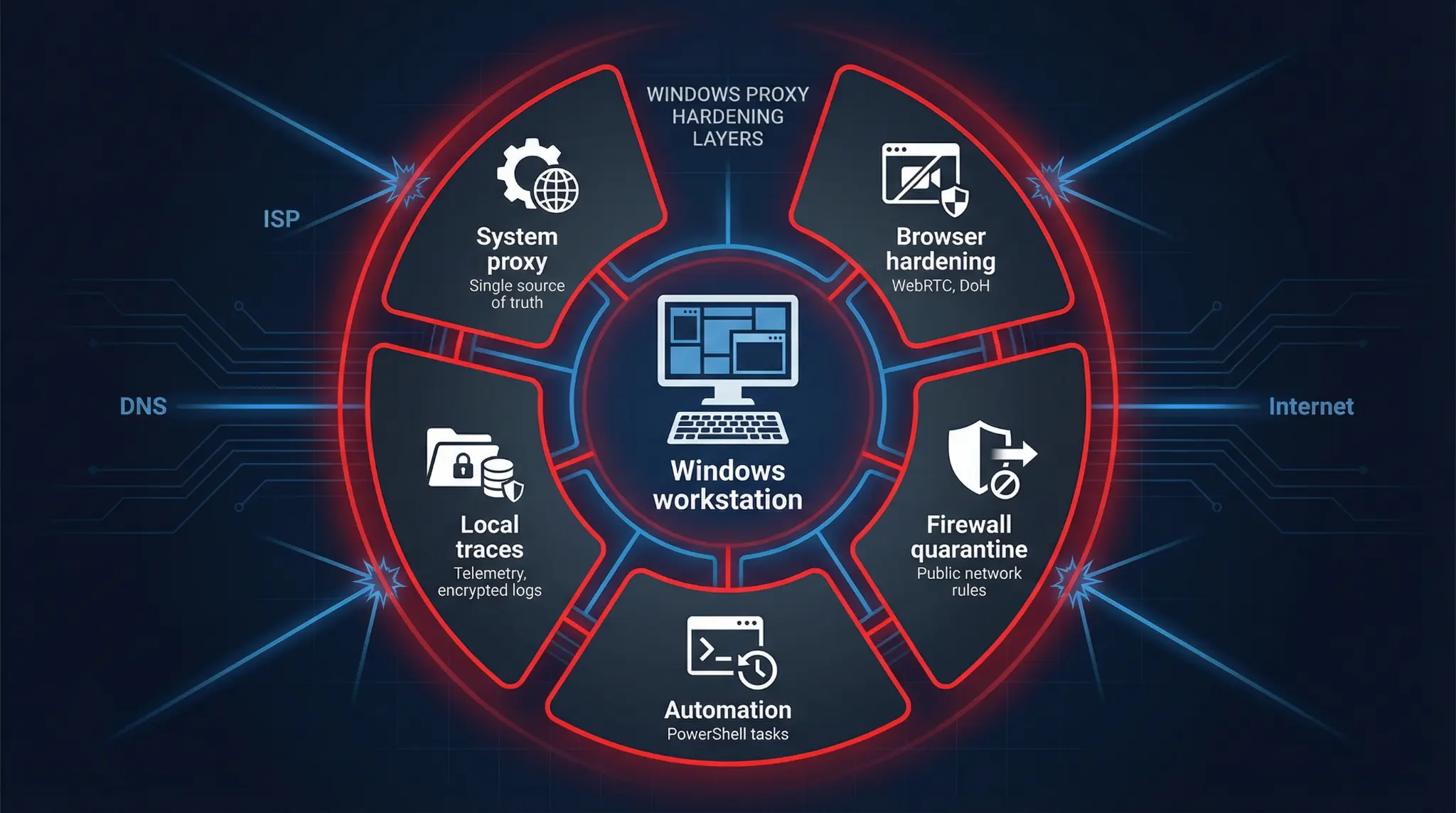
Most proxy leaks start on the workstation. A browser whispers your real IP over WebRTC, DNS caches reveal hosts, or a stray app ignores system proxy settings. Spend ten minutes on these five steps to close the common gaps.
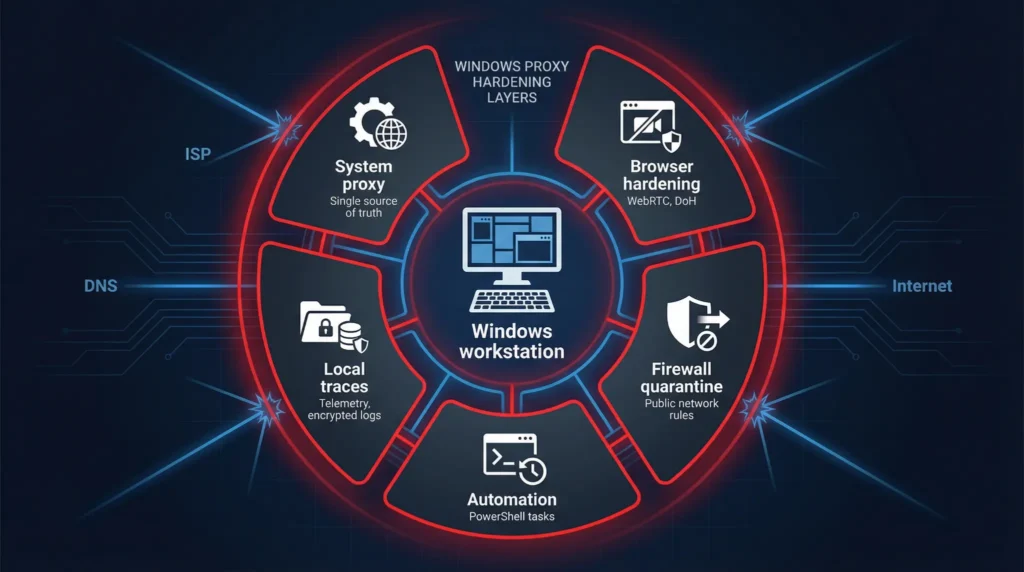
- Set the system proxy. Type proxy settings in the Start menu, add the host, port, and credentials, and select Don’t use proxy for local addresses. This becomes the single source of truth for most apps.
- Lock down the browser.
* Chrome and Edge: visit chrome://flags, disable WebRTC mDNS ICE candidates.
* Firefox: set media.peerconnection.enabled to false in about:config and enable DNS-over-HTTPS. Install your provider’s extension if one exists. - Quarantine other apps. Create an outbound rule in Windows Firewall that allows only the proxy process when the network profile is Public. Switch Wi-Fi to Public before sensitive work; if the proxy drops, traffic stops instead of reverting to your ISP.
- Automate session hygiene. A short PowerShell task can stop the proxy service, run ipconfig /flushdns, call the provider API for fresh credentials, and restart the service on an hourly schedule.
- Minimize local traces. Clear browser history on exit, disable Windows Telemetry (Settings → Privacy & security → Diagnostics & feedback → Send optional diagnostic data off), and store Sysmon logs in an encrypted VeraCrypt volume.
Follow this checklist and you will cut proxy leakage on Windows to near zero. No extra software, no VM rebuilds.
FAQs
Do no-logs proxies make illegal activity safe?
No. A proxy hides your network path, not your identity if investigators already have other evidence. Providers may also terminate accounts used for crime.
Do I still need a VPN if I use a proxy?
Yes. A VPN encrypts every packet and prevents your ISP from reading SNI or DNS queries, while the proxy supplies a disposable exit IP. Together they hide both content and origin.
Can my ISP see which sites I visit when I use an HTTP or SOCKS5 proxy?
Sometimes. If you do not run a VPN, the ISP can still see domain names—unless the site forces HTTPS—so it knows where you went, just not what you did there.
Why does WebRTC keep leaking my IP even with the proxy on?
Browsers open peer-to-peer channels that bypass system proxy settings. Disable WebRTC in your browser or use a hardened tool such as Decodo’s X Browser.
What is the safest way to pay for a proxy?
A privacy-centric credit card or cryptocurrency shortens the paper trail. Pair it with an alias email to further limit exposure.
Conclusion
A zero-logs promise is only as trustworthy as the laws that govern it. Providers can claim privacy, but local authorities can still compel access when the law allows it. Before trusting any service with your data, look beyond marketing and examine the jurisdiction. True privacy depends not on promises, but on the power that can override them.