

































One of the first steps for any individual deciding to trade in the financial markets is answering the question, “Where and how will I trade?” At this point, two primary options usually come to the forefront: opening a personal trading account with a traditional broker or establishing a partnership with a proprietary trading (prop) firm. While both paths offer access to the markets, they significantly differ in their operational methods, the opportunities they present, the responsibilities they entail, and the trader profiles they target.
So, what are the fundamental differences between these two models, and which one might be more suitable for you as a trader? In this article, we will thoroughly examine the advantages, disadvantages, and key distinctions of opening an account with a broker versus working with a prop firm. Our aim is to help you make the most informed decision based on your trading goals and current situation.
Opening a Personal Trading Account With a Broker
Traditionally, the way individual investors and traders have accessed the markets has been through a broker.
● How It Works:
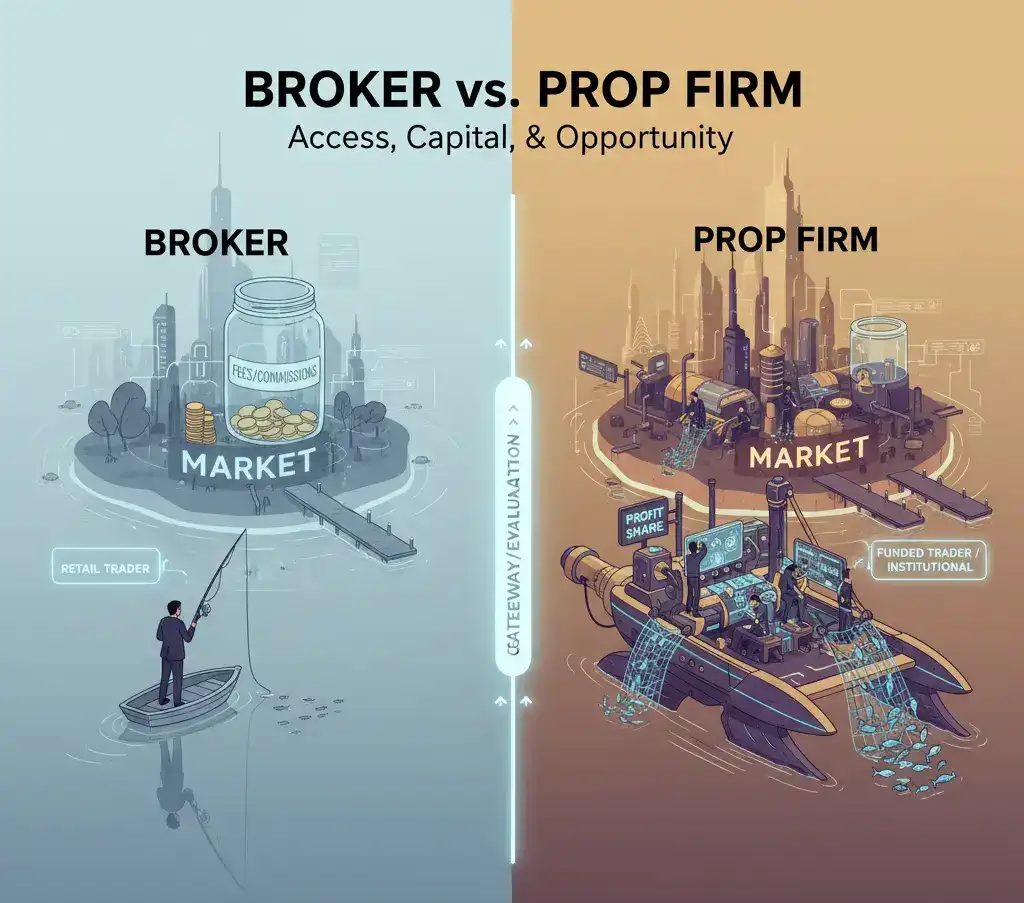
A broker is a financial institution that acts as an intermediary between buyers and sellers. When you open an account with a broker, you deposit your own personal capital into this account. All trading decisions, risk management, and any profits or losses incurred are directly your own. The broker provides you with a platform to execute your trades and typically earns revenue through commissions per trade or spreads (the difference between bid and ask prices).
● Key Features and Advantages:
- Full Control and Flexibility: All capital in your account belongs to you, and you have complete discretion over when, how much, and which instruments you trade. You have full control over your strategies, risk limits, and trading style.
- All Profits Are Yours: All profits you make (after taxes and transaction costs) belong to you. There is no profit-sharing arrangement.
- Wide Range of Instruments: Most brokers offer access to a wide variety of financial instruments, such as stocks, forex, commodities, cryptocurrencies, and indices.
- Different Account Types: Brokers usually offer various account types (standard, ECN, micro, etc.) suited to different capital levels and experience.
- Regulation and Security: Reputable brokers are often regulated by major financial authorities, which provides a certain level of security and assurance for investors.
● Disadvantages and Considerations:
- Personal Capital Risk: Since all trades are made with your own capital, you risk losing your entire investment if market movements go against you.
- Capital Limitation: Especially for beginners or small investors, having sufficient capital to open meaningful positions and manage risks effectively can be challenging. Achieving significant gains with a small account is generally more difficult and may require taking on more risk.
- Psychological Pressure: Risking your own money can create significant psychological pressure, especially when losses occur. This can lead to emotional decision-making.
- Lack of Structure and Discipline: While being your own boss offers freedom, the absence of clear rules and a structure can lead to discipline issues for some traders.
Working With a Prop Firm (Funded Trading)
Prop firms, especially in recent years, have become a popular alternative for talented traders with limited capital.
● How It Works:
A prop firm entrusts its own capital (funds) to traders who prove themselves successful. The trader usually demonstrates their skills and risk management abilities by passing an evaluation process (challenge). If successful, they start trading with a large account provided by the firm and receive a percentage (usually between 70%-90%) of the profits generated.
● Key Features and Advantages:
- Access to Capital: This is the biggest advantage. Prop firms offer traders trading accounts of a size (tens or hundreds of thousands of dollars) that they might not personally possess. This means the potential to open much larger positions with the same skill set and thus achieve higher absolute profits.
- Low Personal Capital Risk: Although a fee is paid to participate in the evaluation process, it is generally low compared to the size of the account to be funded. Once funded, trades are made with the firm’s capital. Losses within the set risk limits are usually covered by the firm, significantly reducing the trader’s personal financial risk.
- Structured Risk Management and Discipline: Prop firms usually set clear risk rules, such as maximum daily loss and maximum total loss. These rules encourage traders to be disciplined and apply consistent risk management. This structure is very valuable, especially for developing traders.
- Profit Share Model: Profits from successful trades are shared between the trader and the firm at a predetermined ratio. This is a win-win model where the firm also benefits from the trader’s success.
- Potential for Education and Support: Some prop firms may offer educational materials, performance analytics, or community forums to support trader development.
- Professional Development: Working with a prop firm can elevate trading to a more professional level and provide valuable experience to the trader. Such an experience can become more tangible, especially when associated with a specific firm. For instance, Forex trading with Fundedtradedmarkets can offer a trader the opportunity to showcase and develop their skills on a large capital base, while also serving as a valuable reference on their resume. This signifies practical expertise gained not just through theoretical knowledge, but under real market conditions with significant account management responsibility.
● Disadvantages and Considerations:
- Evaluation Process: Most prop firms require traders to successfully complete an evaluation process, often consisting of one or more stages, before providing funding. This process can be time-consuming and stressful.
- Not All Profit is Yours: A portion of the profits earned goes to the firm. However, since trading is done with a larger account, the amount düşen to the trader’s share can still be more than the profit they would make with their own small account.
- Rule Restrictions: The trading rules set by prop firms (leverage limits, permitted trading hours, news trading, etc.) may not suit the strategies or trading styles of some traders.
- Firm Selection: There are many prop firms in the market, and not all of them may be of the same quality or reliability. Choosing the right and trustworthy firm is critically important.
Broker or Prop Firm? Which is Right for You?
The answer to this question depends on your individual situation, goals, risk tolerance, and trading experience.
- A Broker Account Might Be More Suitable If:
- You have sufficient personal trading capital.
- You want full control and flexibility in your trading decisions and strategies.
- You want to keep all the profits you make.
- You do not want to be bound by a specific structure or rules.
- A Prop Firm Might Be More Suitable If:
- You believe you are skilled but lack sufficient personal trading capital.
- You want the potential to trade with a larger account.
- You want to trade without risking a large amount of your personal capital.
- You believe working within a structured and disciplined framework will contribute to your development.
- You want to develop your risk management skills and test them in a professional environment.
The Instant Funding Option: A Different Prop Firm Model
Some prop firms, in addition to or instead of traditional evaluation processes, also offer “instant funding” programs. In this model, traders can bypass lengthy evaluation stages and start trading directly with a funded account, usually for a specific fee. This option can be attractive for disciplined and generally more experienced traders who are highly confident in their strategies. However, these programs often come with stricter risk rules or more controlled initial account sizes, as the firm will be observing the trader’s performance directly on a live account.
Conclusion: Make an Informed Decision
Both opening a personal account with a broker and working with a prop firm have their unique advantages and disadvantages. The important thing is to fully understand what both models offer and choose the one that best suits your trading goals, financial situation, and risk appetite.
If capital is not a barrier for you and you prefer full control, a broker account might be the right path. However, if you are confident in your abilities but lack access to large capital and want to seize the opportunity to trade with a large account in a more structured environment, working with a reputable prop firm can be a significant stepping stone in your trading career. Do your research, carefully evaluate your options, and take informed steps on your trading journey.