

























Every second counts in a Security Operations Center. But just how fast do real-world SOC teams move — and what does “fast enough” actually mean? There’s a benchmark circulating among practitioners that cuts right through the industry noise: the 3-minute alert rule.
The Rule: Ambitious, But Not Impossible
The 3-minute alert rule is a practitioner’s shorthand for the ideal maximum time a SOC analyst should spend triaging a single alert before either escalating it or closing it as a false positive. The logic is simple: if analysts take longer, the alert backlog grows faster than the team can clear it, and real threats get buried in noise.
The benchmark exists for good reason. Industry data shows the scale of the problem analysts face. Organizations now receive an average of 2,992 security alerts daily, yet 63% go unaddressed. A typical enterprise-grade SOC may see upward of 3,800 alerts per shift — a number no team can manually investigate at depth. When nearly half of all alerts prove to be false positives, the pressure to move fast while staying accurate is relentless.
The math behind three minutes is straightforward: an 8-hour shift with a single analyst, working continuously, allows for roughly 160 triage decisions. Spread across a real team, that’s manageable — but only if each decision is fast and informed. Drag that number to five or eight minutes per alert, and the backlog becomes structurally unwinnable.
Is three minutes actually achievable?
In practice, the answer is: sometimes, for some alerts, with the right tooling.
Industry benchmarks for critical incidents generally target a Mean Time to Acknowledge (MTTA) of under 15 minutes and a Mean Time to Respond (MTTR) of under one hour. Three minutes for triage — not full investigation — sits comfortably within this frame. Triage answers one question: Is this alert worth escalating? That decision can be made in three minutes when analysts have instant access to context. Without that context, the same decision might take twenty.
The 3-minute alert rule isn’t a hard SLA: it’s a design constraint. Teams that build their workflows around it are forced to make good architectural decisions: they invest in enrichment tools, tune detection rules to reduce noise, automate repetitive lookups, and define clear escalation thresholds. The benchmark drives maturity. Teams that ignore it tend to rationalize slow processes until a critical alert gets missed or delayed, and then wonder why.
The adversary has no equivalent hesitation. Threat actors using automated tooling can move from initial foothold to lateral movement in under an hour. A SOC that spends 15 minutes deciding whether an IP is malicious has already surrendered a significant portion of that window.
Threat Intelligence as the Engine of Fast Triage
If three-minute triage is the goal, threat intelligence is the mechanism that makes it achievable. It doesn’t just tell you whether an indicator is bad. It tells you why, when, how, and what to do about it. The difference is operationally significant:
1. Immediate verdict on indicators.
A hash, IP, URL, or domain looked up against a live threat intelligence database returns a known-malicious or unknown verdict within seconds. That single data point narrows the triage decision from a blank slate to a focused binary. This is how it works in ANY.RUN’s Threat Intelligence Lookup:
Search query destinationIP:”85.17.40.98″
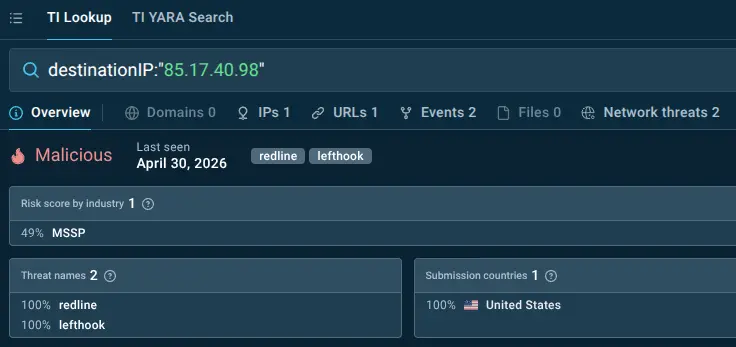
Instant “malicious” verdict on a suspicious domain in TI Lookup
2. Malware family and campaign attribution
Knowing that an IP resolves to infrastructure associated with a specific ransomware group or infostealer campaign changes the severity calculus immediately. It converts a generic “suspicious outbound connection” alert into a specific, prioritized response action.
| Employ intelligence-driven threat hunting to reduce alert investigation time and improve accuracy. |
Example: TI Lookup links an IP to Vjw0rm, a notorious modular JavaScript RAT:
Search query destinationIP:”124.198.131.136″
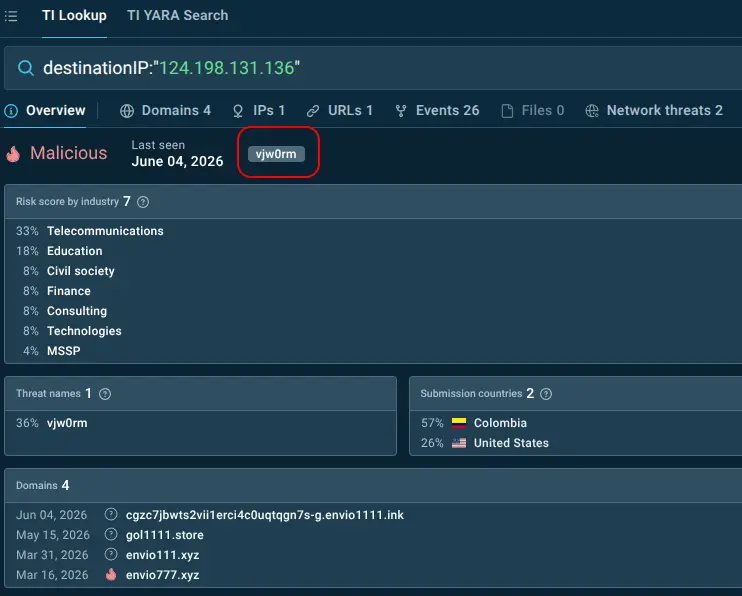
IP attributed as Vjw0rm infrastructure
3. Alert prioritization based on real threat activity
Two domains may appear equally suspicious, but one may have been observed in active malware campaigns during the last week, while the other has little evidence of malicious use. Threat intelligence provides the context necessary to distinguish genuine threats from low-priority noise.
Example: TI Lookup shows that it’s been several month since the investigated domain had been spotted in malware sandbox detonations. Linked IOCs are also obsolete.
Search query domainName:”familyriwo.su”
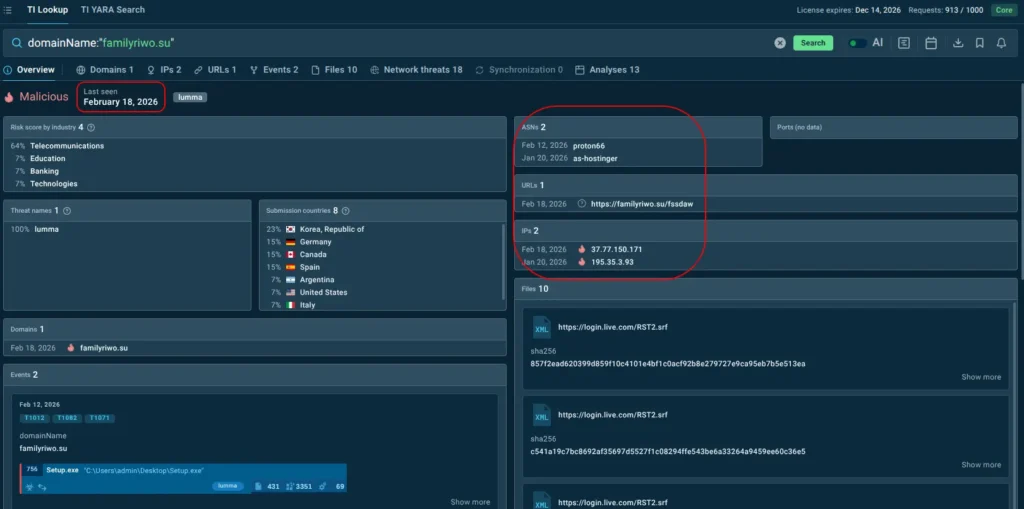
IOC freshness detection in TI Lookup
4. Investigating indicators using natural language queries
During alert triage, analysts often know what they need to find but lose time building complex search queries.
Threat Intelligence Lookup’s AI Search Assistant simplifies the process by allowing analysts to search in natural language. The assistant automatically converts these requests into structured searches and returns relevant threat intelligence data, helping analysts gather context faster and make confident decisions within the three-minute triage window.
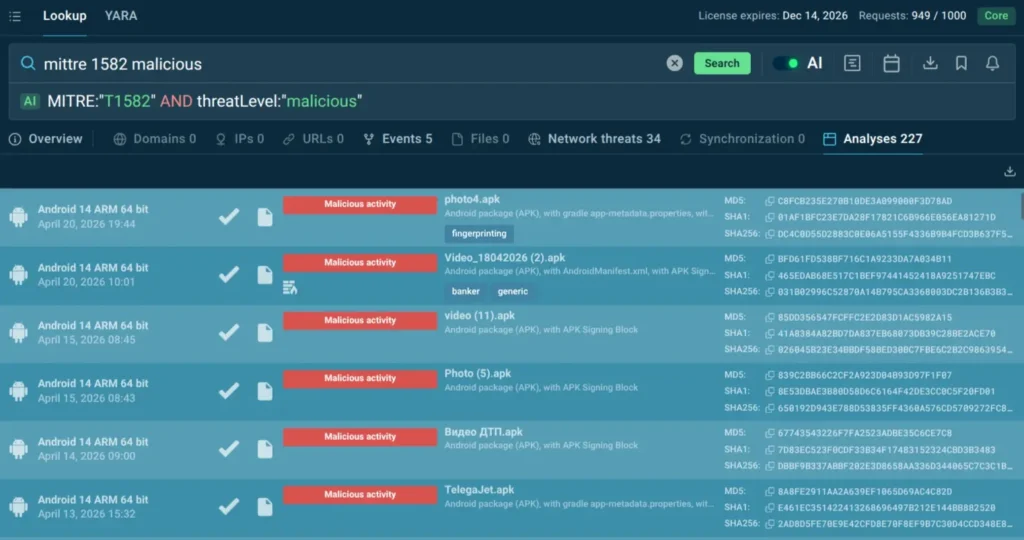
AI assistant interprets a lookup request in natural language, helps select sandbox analyses of malware using a TTP
5. Running YARA-based threat hunting alongside alert triage
YARA Search within TI Lookup allows analysts to build or apply custom YARA rules against the platform’s entire database of sandbox sessions. Rather than waiting for an alert to appear in the SIEM, analysts can proactively scan for behavioral patterns associated with the threat actor — registry modifications, file naming conventions, process injection techniques — and surface related samples and IOCs before they trigger detection rules.
This is threat hunting with actual data behind it. When a YARA rule matches, it returns full sandbox sessions showing the attack in action, complete with behavioral timelines, network maps, and ATT&CK technique lists. The result is proactive detection that doesn’t depend on signatures catching up to attacker behavior.
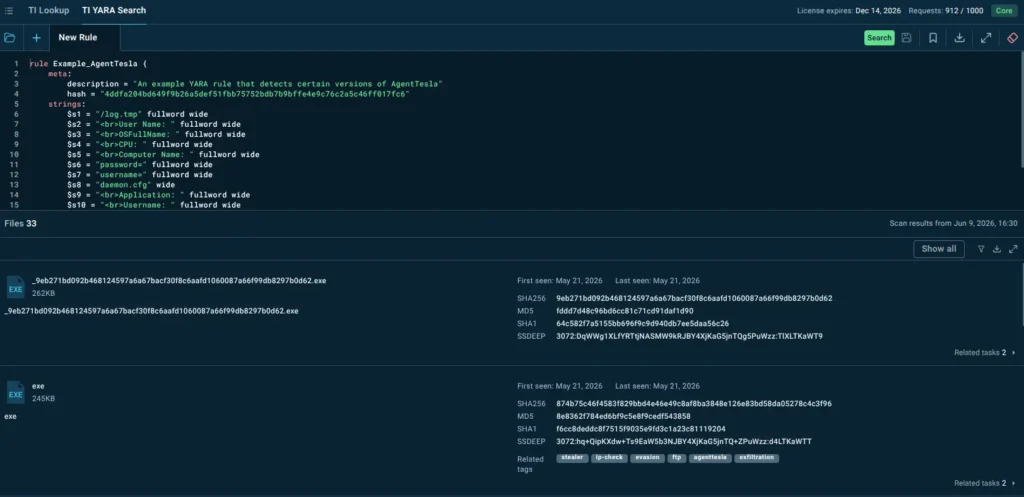
YARA search for AgentTesla malware
Closing Thoughts
The 3-minute alert rule is, like most benchmarks, a target rather than a mandate. But it reflects a real operational truth: in an environment where adversaries move in under an hour and analysts face thousands of alerts per shift, the teams that win are the ones who have made fast, informed triage structurally achievable — not dependent on individual heroics.
Threat intelligence is the engine that makes that possible. And solutions like ANY.RUN’s Threat Intelligence Lookup — with rapid response, behavior-backed IOC context, YARA search, and data sourced from live community-driven sandbox analysis — give SOC teams the information density needed to actually hit that benchmark, repeatedly, at scale.
The alerts aren’t slowing down. The question is whether your triage process can keep up.
| Give your hunters the context they need. Use ANY.RUN Threat Intelligence to connect indicators, behaviors, malware, and threat actors in a single workflow. |