


































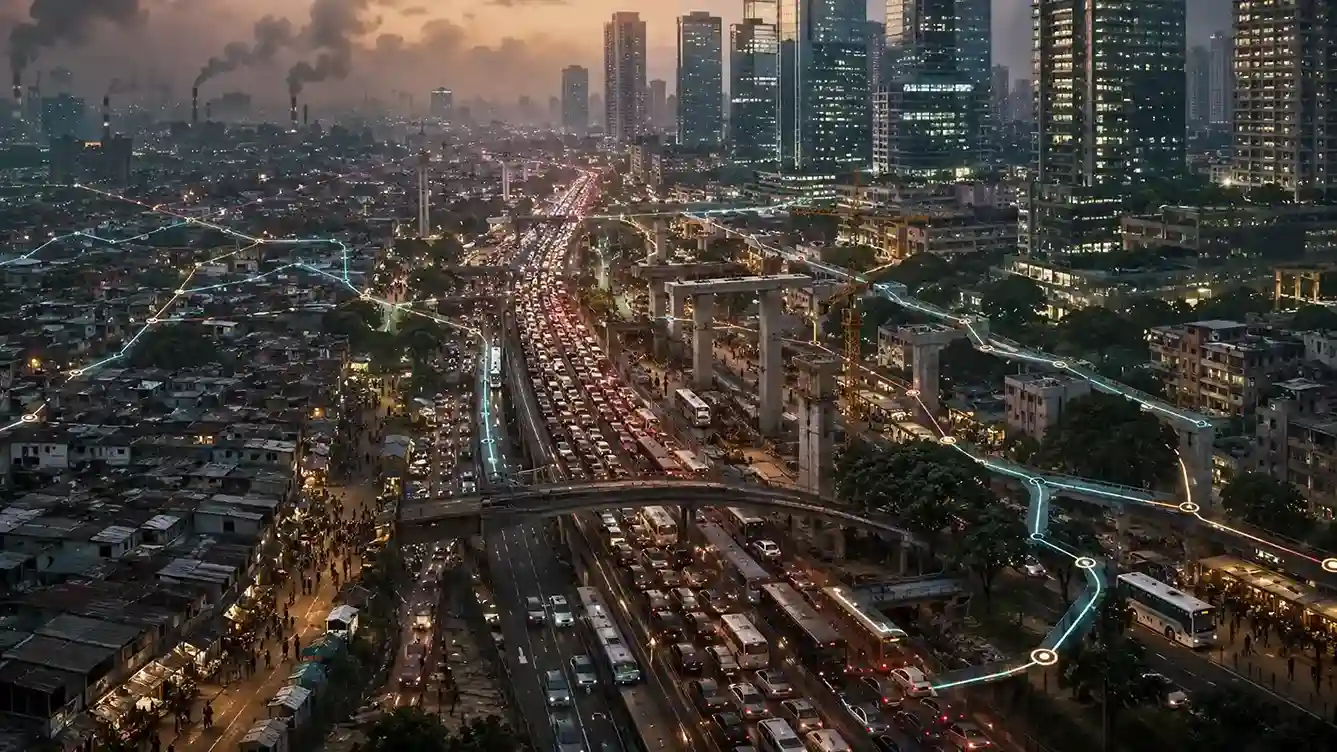
Traffic congestion has long been treated as a technical issue. More cars than road capacity leads to slower movement, longer journey times, and increased fuel consumption. The conventional response has been equally technical: expand road networks, adjust signal timing, or introduce congestion charges.
But modern congestion behaves differently from the models that once defined it.
Today, traffic is no longer just a transport problem. It is a reflection of urban inequality, infrastructure design choices, environmental constraints, and the unintended consequences of digital navigation systems that redistribute congestion rather than eliminate it.
Understanding modern traffic requires looking beyond roads themselves and into the systems that shape how people move through cities.
The Limits of Expanding Road Capacity
For decades, the dominant solution to congestion was simple: build more roads.
However, urban planning research has repeatedly shown that increasing road capacity often leads to induced demand. As driving becomes easier, more people choose to drive, eventually restoring congestion levels to their previous state or worse.
This creates a cycle where infrastructure expansion temporarily relieves pressure but does not fundamentally solve the underlying issue of demand.
In dense urban environments, physical expansion is also limited by geography, cost, and existing development. Cities cannot endlessly widen roads or add new arteries without significant social and economic trade-offs.
As a result, congestion persists not because of insufficient engineering effort, but because the problem itself is not purely engineering-based.
Inequality and the Geography of Congestion
Traffic patterns often mirror economic and social inequality.
In many cities, congestion is concentrated in areas where employment centres, affordable housing, and transport infrastructure do not align efficiently. Workers commuting from lower-cost residential zones into central business districts create predictable congestion corridors.
At the same time, wealthier areas may experience lighter traffic due to different commuting patterns, remote work flexibility, or better access to alternative transport options.
This creates a spatial mismatch between where people live and where economic activity is concentrated. Congestion becomes a symptom of broader structural inequalities rather than simply a failure of traffic management.
In this sense, traffic is not evenly distributed—it is socially patterned.
The Role of Digital Navigation Systems
One of the most significant but often overlooked contributors to modern congestion is digital navigation.
Real-time routing systems were designed to reduce travel time for individual drivers. However, when millions of users rely on the same optimisation algorithms, the system begins to redistribute congestion rather than eliminate it.
When a major route becomes congested, navigation apps redirect drivers onto alternative roads. Over time, this can shift congestion into residential streets, secondary roads, and previously quiet neighbourhoods.
The result is not less congestion, but more widely distributed congestion.
Local streets that were never designed for high-volume traffic can become temporary pressure valves for the wider network. This changes not only travel patterns but also the lived experience of urban environments.
Congestion, in this context, becomes a dynamic system shaped by algorithmic decision-making rather than static infrastructure limitations.
Environmental Policy and Behavioural Feedback Loops
Environmental regulations are also reshaping congestion patterns.
Low-emission zones, congestion charges, and restrictions on older vehicles are designed to reduce pollution and encourage cleaner transport choices. While these policies often succeed in reducing emissions, they can also influence traffic distribution in complex ways.
Some drivers adjust routes to avoid regulated zones, while others shift travel times or modes of transport. In certain cases, congestion can intensify at the boundaries of restricted areas as traffic is displaced rather than reduced.
Electric vehicle adoption adds another layer of complexity. While EVs reduce tailpipe emissions, they do not inherently reduce road usage. In fact, lower operating costs can sometimes encourage increased driving, partially offsetting congestion improvements.
This creates a policy tension between environmental goals and transport efficiency.
The Urban Design Factor
City design plays a foundational role in how congestion emerges and persists.
Grid-based layouts, radial road systems, and historical infrastructure decisions all influence how traffic flows today. Cities that evolved around older transport models—horse-drawn routes, early industrial expansion, or limited zoning foresight—often struggle to adapt to modern mobility demands.
In contrast, newer urban developments can integrate multi-modal transport planning more effectively, incorporating public transit, cycling infrastructure, and pedestrian zones from the outset.
However, retrofitting older cities is far more complex. Road networks that have evolved over centuries cannot easily be redesigned without significant disruption.
As a result, congestion often reflects historical decisions as much as current ones.
Behavioural Adaptation in Congested Systems
Drivers do not simply experience congestion—they adapt to it.
Over time, people change departure times, select alternative routes, or shift modes of transport based on repeated exposure to traffic conditions. This adaptive behaviour creates feedback loops within the transport system.
For example, if a particular route becomes known for congestion at a specific time, drivers may avoid it, temporarily reducing pressure. However, this can shift congestion to other routes or time windows, creating new patterns of peak demand.
Congestion is therefore not a fixed state but a constantly evolving system influenced by collective behavioural response.
The Hidden Economic Cost of Delay
Beyond inconvenience, congestion carries significant economic implications.
Time lost in traffic affects productivity, logistics efficiency, and service delivery. Supply chains become less predictable, and businesses operating in congested regions face higher operational costs.
However, these costs are often distributed unevenly. Individuals bear time delays, while businesses absorb logistical inefficiencies, and cities experience broader productivity impacts.
This makes congestion a multi-layered economic issue rather than a single measurable loss.
Cars, Identity, and the Broader Urban Ecosystem
While congestion is primarily a systems issue, it also interacts with how people relate to vehicles culturally.
Cars are not only transport tools but also expressions of identity, mobility, and autonomy. In dense urban environments, this relationship becomes more complex as driving is increasingly shaped by external constraints such as policy, infrastructure, and digital routing systems.
Within this broader automotive ecosystem, even aspects of vehicle identity and presentation sit alongside how drivers experience urban mobility. In this context, companies such as Plates Express exist within a wider landscape of automotive culture where personalisation and identity remain relevant even as mobility systems evolve.
Conclusion
Traffic congestion can no longer be understood as a purely transport engineering problem. It is the outcome of overlapping systems: urban design, economic geography, environmental policy, behavioural adaptation, and digital navigation technologies.
Each layer influences how, when, and where people move, often in ways that reinforce congestion rather than resolve it.
Solving modern congestion therefore requires more than expanding infrastructure. It requires understanding the interconnected systems that shape mobility itself.
In this context, traffic is not just a symptom of too many cars on the road. It is a reflection of how cities are structured, how people live within them, and how technology increasingly mediates the movement between them.