
































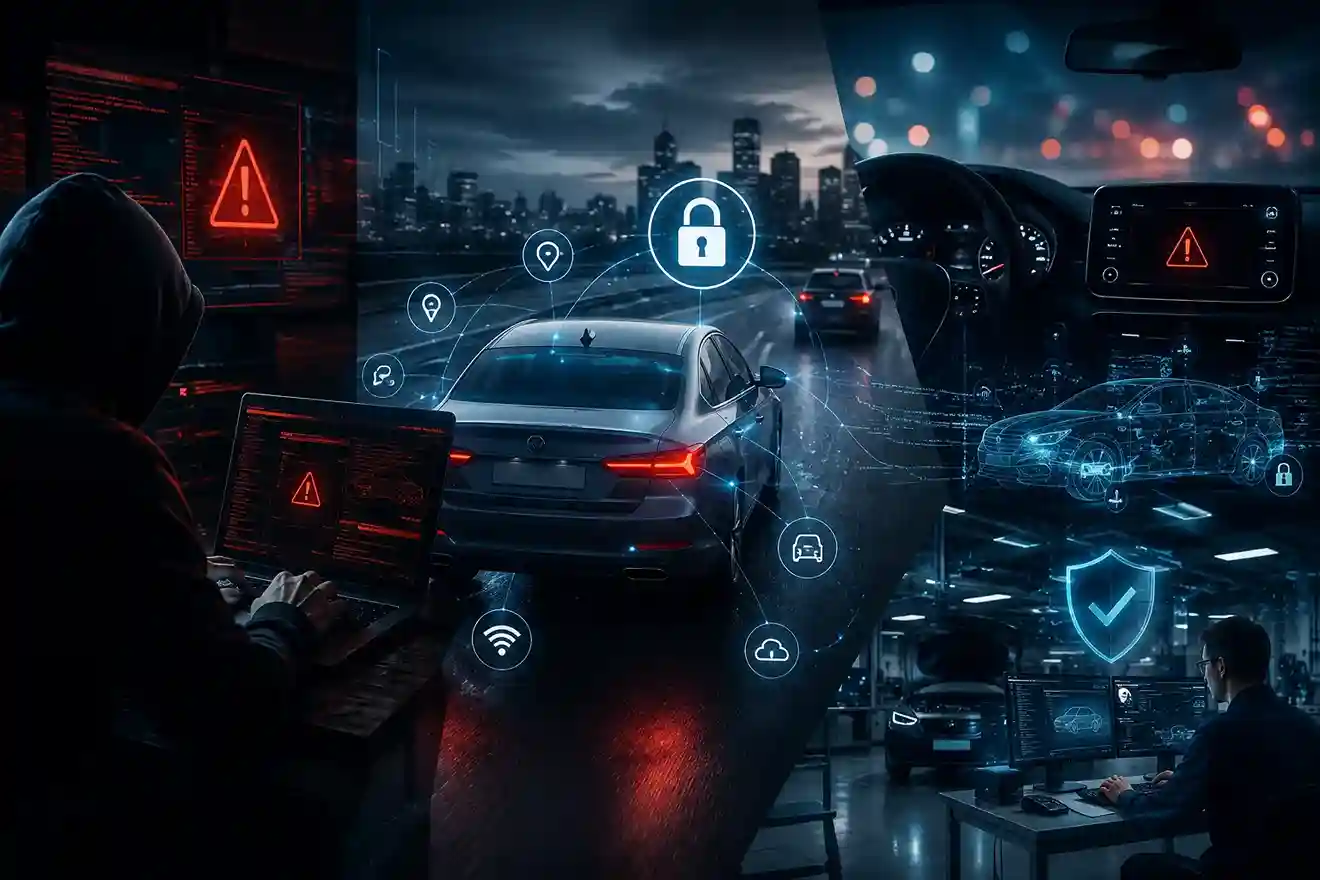
Modern cars are no longer purely mechanical machines. They are computers on wheels—connected, software-driven systems that rely on complex networks of sensors, modules, and wireless communication. This shift has delivered major improvements in safety, efficiency, and convenience. It has also introduced a new and less visible risk: cybersecurity vulnerabilities.
The idea of someone “hacking a car” once sounded like science fiction. Today, it is a documented reality, though not in the dramatic, Hollywood sense of remote-controlled chaos on every street. Instead, real automotive cyberattacks tend to be targeted, technical, and carefully constrained—but still serious enough to reshape how manufacturers design vehicles.
How Modern Cars Became Vulnerable
To understand automotive hacking, it helps to understand how connected modern vehicles actually are.
A typical car today contains dozens of electronic control units (ECUs), each responsible for a different function: engine management, braking systems, steering assistance, infotainment, and more. These systems communicate through internal networks, often using protocols designed decades ago when cybersecurity was not a major concern.
As connectivity increased—through Bluetooth, Wi-Fi, mobile apps, and telematics systems—new entry points emerged. What was once an isolated mechanical system is now partially exposed to external digital environments.
This does not mean cars are easily hijacked. But it does mean that, like any connected device, they can have weak points.
Documented Real-World Car Hacking Cases
One of the most widely cited demonstrations of automotive hacking came in 2015, when security researchers remotely accessed a Jeep Cherokee through its infotainment system. They were able to manipulate non-critical systems such as radio and air conditioning, and in controlled conditions, interfere with steering and braking while the vehicle was in motion.
Importantly, this was not a random attack on a road user—it was a controlled experiment designed to expose vulnerabilities. But it led to a large-scale recall and forced manufacturers to rethink how connected systems interact with safety-critical components.
Other demonstrations have followed similar patterns:
- Researchers have shown how keyless entry systems can be intercepted using relay attacks, allowing vehicles to be unlocked without physical keys.
- Infotainment systems have been exploited in lab environments to gain access to internal vehicle networks.
- Fleet management systems and telematics platforms have been targeted in proof-of-concept studies, highlighting risks in commercial vehicles.
In nearly all cases, the goal was not theft or harm, but exposure of weaknesses before they could be exploited maliciously at scale.
Why Full “Remote Takeover” Is Still Rare
Despite these demonstrations, the idea of hackers randomly taking control of cars on public roads remains unlikely in practice. There are several reasons for this.
First, modern vehicles are increasingly segmented internally. Safety-critical systems like braking and steering are typically isolated from entertainment or connectivity systems. This architectural separation limits how far an intrusion can spread.
Second, manufacturers have significantly improved cybersecurity practices over the past decade. Over-the-air updates, encryption protocols, intrusion detection systems, and secure boot processes are now standard in many new models.
Third, exploiting a vehicle remotely is complex. It often requires highly specific conditions: a particular software version, an unpatched vulnerability, and proximity or access to a connected system. This level of precision makes large-scale attacks difficult to execute.
The Growing Target: Connected and Autonomous Systems
While full vehicle “takeovers” remain rare, the attack surface is expanding.
The rise of connected services has introduced new areas of risk:
- Mobile apps linked to vehicles can be targeted if authentication is weak
- Cloud-based vehicle platforms may be vulnerable to data breaches
- Charging infrastructure for electric vehicles introduces another digital layer
- Semi-autonomous driving systems rely heavily on software updates and sensor fusion
As vehicles become more autonomous, the stakes increase. It is not just about access to entertainment systems—it is about systems that influence steering, braking assistance, and environmental awareness.
This is why automotive cybersecurity is now treated as a core engineering discipline rather than an afterthought.
How Manufacturers Are Responding
Car manufacturers and suppliers have begun adopting cybersecurity practices more commonly associated with the tech industry.
Key strategies include:
- Segmentation of systems: Isolating critical driving functions from infotainment networks
- Encryption: Protecting communication between vehicle components and external servers
- Secure over-the-air updates: Allowing vulnerabilities to be patched without dealership visits
- Penetration testing: Hiring ethical hackers to identify weaknesses before release
- Intrusion detection systems: Monitoring unusual activity within vehicle networks
In some regions, regulatory frameworks are also emerging. For example, international automotive cybersecurity standards now require manufacturers to demonstrate risk management processes before vehicles can be sold in certain markets.
The Human Factor: Where Many Risks Actually Start
Interestingly, many real-world vehicle security issues do not come from remote hacking attempts, but from human behaviour.
Keyless entry relay attacks, for example, often rely on proximity to a key fob rather than digital intrusion. Weak passwords for connected apps, reused credentials, or phishing attempts targeting account access can also create vulnerabilities.
In other words, the weakest point is often not the vehicle itself, but the ecosystem around it.
The Intersection of Security and Vehicle Identity
As vehicles become more digital, they also become more personalised. Drivers now expect cars to remember preferences, sync with devices, and adapt to individual usage patterns. This blending of identity and mobility raises new questions about data ownership and security.
Even elements of physical customisation, from interior design choices to exterior styling, sit alongside this digital identity layer. The automotive experience is no longer just mechanical or aesthetic—it is increasingly informational.
In this evolving landscape, companies such as Number 1 Plates operate within the broader culture of vehicle personalisation, where design, identity, and presentation intersect with modern automotive ownership.
So, Can Cars Be Hacked?
The most accurate answer is: yes, but not in the way people often imagine.
Cars can be—and have been—exploited through software vulnerabilities, especially in controlled research environments. However, modern vehicles are not easily or casually hijacked. Most risks today are mitigated through layered security systems, rapid patching, and increasingly strict engineering standards.
The real challenge is not whether cars can be hacked, but how quickly the industry can adapt to an environment where vehicles are permanently connected, constantly updated, and increasingly autonomous.
Conclusion
Automotive hacking is not a distant threat or a cinematic scenario—it is a real and evolving field that sits at the intersection of cybersecurity and engineering. While dramatic “remote takeover” scenarios are rare and heavily constrained, the growing complexity of connected vehicles ensures that cybersecurity will remain a central concern for the industry.
As cars continue to evolve into software-defined machines, the question is shifting from whether they are vulnerable, to how resilient they can become in a permanently connected world.