

















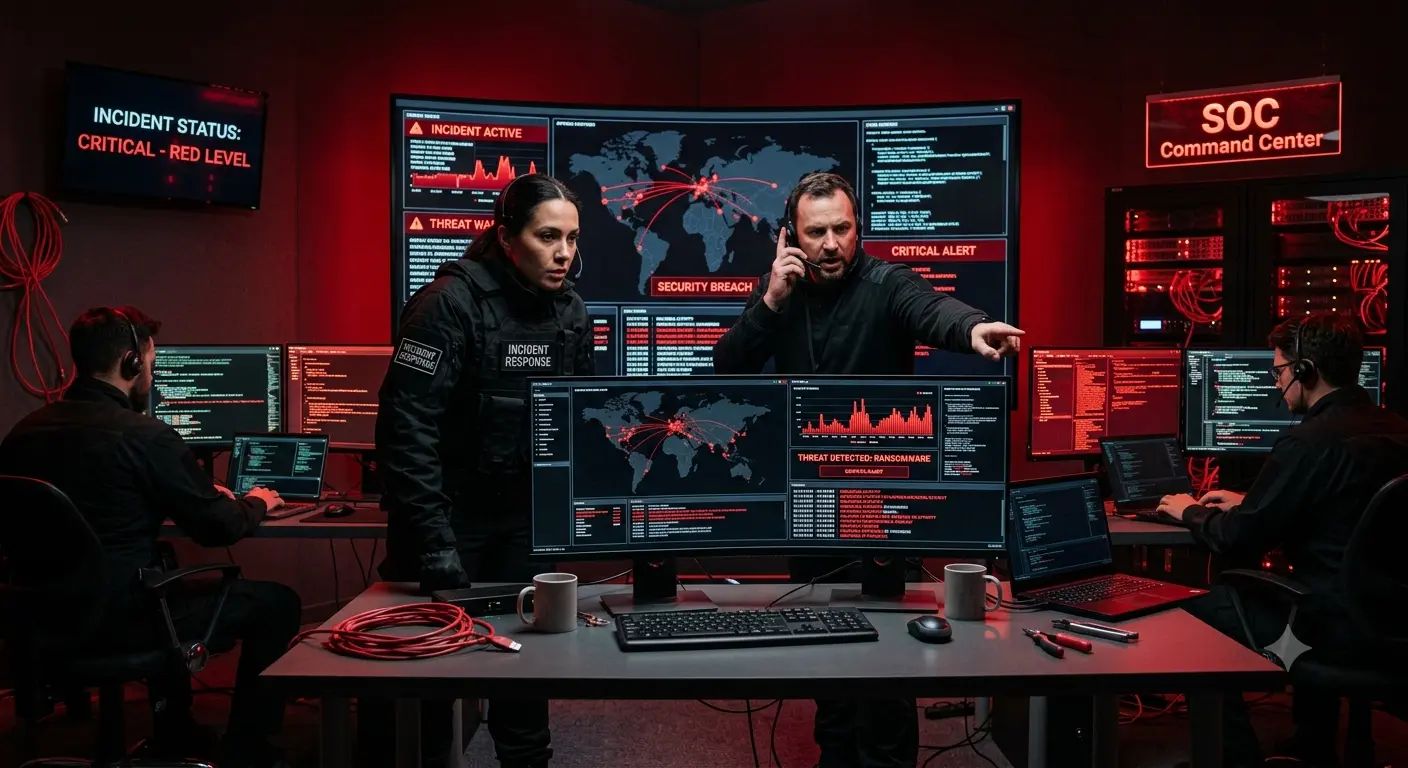
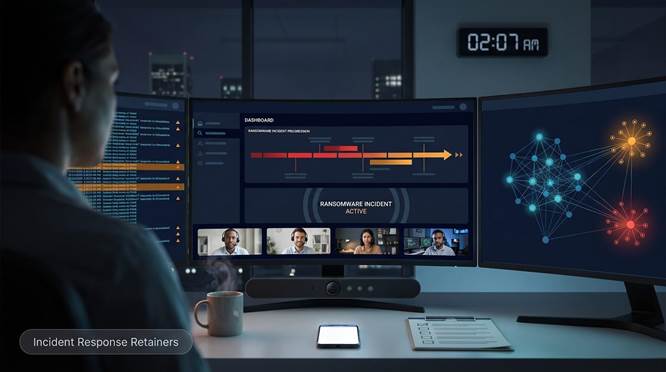
Cyber attacks don’t wait for contracts. When ransomware detonates at 2 a.m., the only thing that matters is how fast experts can jump on a bridge, contain the blast, and document every step for regulators.
Most companies aren’t ready. Sygnia’s 2026 CISO Survey found 73 percent of organizations do not feel prepared to withstand a cyberattack without disruption. The fallout: lost revenue, missed disclosure deadlines, and frantic midnight calls to lawyers and insurers.
An incident-response (IR) retainer flips that script. You pre-negotiate rates, response-time guarantees, and how unused hours convert into proactive services. When trouble hits, one call brings the cavalry, often within one or two hours, while competitors are still emailing procurement.
This guide walks you through seven providers we trust most for 2026. Each excels in a different scenario: lightning-fast containment, deep regulatory support, Microsoft-centric cloud forensics, and more. We’ll compare SLAs, pricing models, and whether leftover hours roll into tabletop drills, so your budget never burns.
Scan the quick table, dive into the mini-profiles, then grab the checklist at the end to vet any IR vendor like a pro. When the worst day comes, and it will, your board deserves calm, scripted confidence, not chaos.
Ready? Let’s lock in your safety net before the next alert pops.
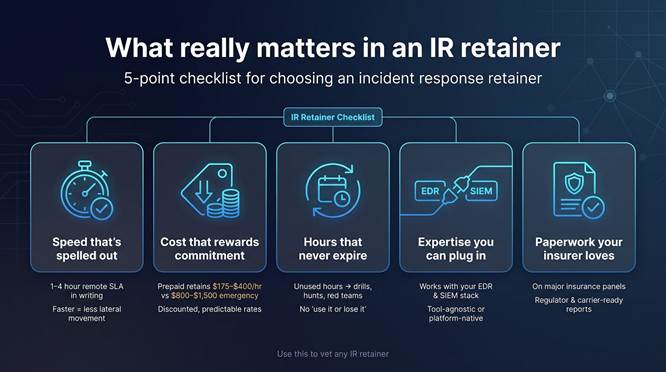
What really matters in an IR retainer
Speed that’s spelled out.
A retainer is only as good as the time it locks in. Push for a written service-level agreement that promises remote triage within one to four hours and clear escalation paths to on-site help. Anything slower gives malware extra time to fan out across your network.
Cost that rewards commitment.
Emergency, no-retainer work often runs $800-$1,500 an hour, while prepaid retainers can lock the same talent at $175-$400. That delta isn’t marketing fluff; it comes from market-wide pricing bands pulled from major IR firms. Pre-paying secures priority and predictable billing when panic sets in.
Hours that never expire.
Great vendors let you roll unused minutes into tabletop drills, threat hunts, or red-team tests. If a firm says “use it or lose it,” you’re effectively betting on disaster every year.
Expertise you can plug in.
Ask whether the team works with your existing EDR and SIEM or insists on deploying its own stack mid-crisis. Tool-agnostic responders integrate faster; platform vendors deliver slick visibility but may need rapid agent rollouts first.
Paperwork your insurer loves.
Regulators and carriers now scrutinize forensic reports. Choose partners on major insurance panels who already know the templates adjusters expect. The right name on that document can shave weeks off a claim.
Keep these checkpoints handy. In the next section we’ll map each provider against them so you can spot strengths and gaps at a glance.
At-a-glance: how the top providers stack up
We distilled hundreds of pages of data into a one-screen cheat sheet.
Use it as your side-by-side sanity check before we unpack each vendor’s nuances.
The speed column reflects standard industry SLAs and frameworks. Sygnia typically guarantees remote response within two hours, while CrowdStrike’s 1-10-60 model targets investigation in under ten minutes and containment in under 60 minutes.
Pricing tiers reference market-wide bands that compare prepaid retainers with emergency, ad hoc work.
| Provider | Remote SLA | Retainer model | Unused hours? | Stand-out strength |
| Sygnia | 1-2 h remote / < 24 h on-site | Prepaid blocks | Yes → drills & hunts | Elite “battle-mode” responders |
| Mandiant | ≈2 h remote / ~4 h on-site | Prepaid or $0 paper | Case-by-case | Global threat intel network |
| CrowdStrike | 1-10-60 benchmark, not contractual | Prepaid hours | Limited rollover | Tech-powered lightning containment |
| IBM X-Force | 4 h remote | Prepaid via AWS Marketplace | Encouraged for consulting | Audit-ready chain-of-custody |
| Kroll | 2-4 h remote | Flexible prepaid | Yes → proactive services | Insurance-panel favorite |
| Deloitte | ~4 h multi-discipline team | Annual prepaid | Use-it or lose-it | Legal, PR, and DFIR in one call |
| Microsoft DART | 2 h remote | Retainer or hourly | No | Deep Microsoft cloud forensics |
Scan the columns, circle the must-have line for your org, and keep reading; we’re about to explore each provider’s real-world strengths and gaps.
1. Sygnia: best for rapid, stealth response
Sygnia grew out of Israel’s cyber-intelligence ecosystem, and it shows.
Its 2026 CISO Survey on incident response readiness found visibility gaps, untested recovery procedures, and weak stakeholder coordination to be the primary reasons organizations buckle under pressure.
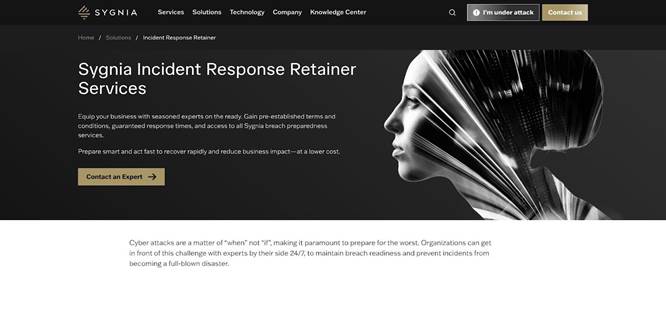
Sygnia incident response retainer services page screenshot
When a Fortune-100 network lights up at 3 a.m., the firm’s “battle-mode” team can be on a video bridge in under two hours and wheels-up the same day if on-site forensics are needed.
Speed is only half the story.
Sygnia bakes readiness into the contract: any retainer hour you don’t burn during a crisis rolls into tabletop drills, threat hunts, or red-team tests. Your budget strengthens defenses instead of expiring at year-end.
Boards love the discretion factor.
Responders operate on strict need-to-know protocols, often resolving breaches before headlines surface. That quiet approach keeps legal exposure low and brand equity intact.
Cost lands at the premium end, often in the six-figure range for a robust block of hours, but clients aren’t paying for junior analysts. Senior operators with nation-state backgrounds lead every engagement, so troubleshooting never slips into “let us escalate” limbo.
Finally, insurers take note.
Sygnia appears on multiple carrier approved-responder panels, so claims move through paperwork checks instead of stalling over vendor vetting.
Bottom line: if you want elite speed, rollover value, and iron-clad confidentiality, Sygnia is the retainer that lets you sleep at night, even when attackers don’t.
2. Mandiant: best for global intelligence and board-level credibility
Mandiant earned its stripes uncovering nation-state hacks long before most companies had a SOC.
Today the team fronts Google Cloud’s security arm, yet it still operates like the classic cyber SWAT unit boards cite in emergency playbooks.
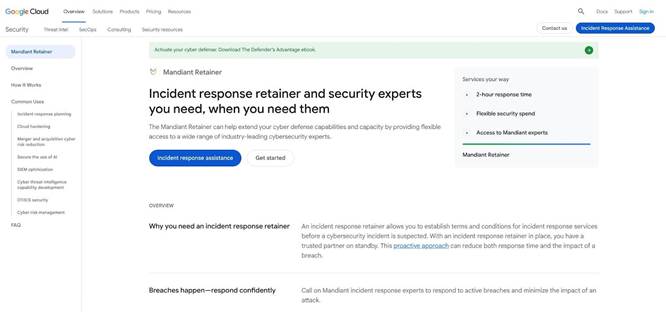
Mandiant incident response retainer services page screenshot
Response time is quick, and the paperwork is quicker.
Mandiant offers a $0 “paper retainer” that locks in rates and legal terms ahead of time, so procurement never slows you down when the clock is ticking. Upgrade to a prepaid block and you gain a target remote SLA of roughly two hours.
Why pay the premium?
Because Mandiant’s threat-intelligence engine pulls from breaches across more than 30 countries, letting analysts match indicators in your logs to adversary playbooks within minutes. That context means faster scoping, cleaner containment, and executive reports regulators accept on first pass.
Cost aligns with the firm’s pedigree.
Emergency, out-of-contract work soars past $800 per hour, while prepaid retainers settle closer to the $175-$400 band seen across the industry. The delta buys you instant access to responders who have managed SolarWinds-scale intrusions up close.
If your board wants a household name on call, and you value intel as much as hands-on keyboards, Mandiant is the safe bet that still moves at startup speed.
3. CrowdStrike: best for lightning-fast, tech-powered containment
CrowdStrike’s claim to fame is speed.
Once you sign the retainer, responders can push Falcon sensors to every endpoint in minutes. CrowdStrike publishes the 1-10-60 benchmark as its performance goal: detect in one minute, investigate in ten, contain in sixty. Treat it as a target the platform is built around, not a number written into your contract. Attackers lose lateral movement time before they reach your crown jewels.
CrowdStrike incident response and Falcon platform screenshot
That power comes from pairing people with a battle-tested platform.
Falcon’s cloud console shows real-time attacker paths, so your IT team watches the takedown unfold instead of reading a report after the fact. Visibility breeds trust and slashes the back-and-forth that usually burns billable hours.
The retainer is prepaid, and the math tilts in your favor if you already license Falcon.
Clients with full-stack deployments tap into a breach warranty worth up to $1 million, turning every “what if” chat with finance into a clear risk-transfer story.
Trade-offs exist.
CrowdStrike’s model expects you to run or quickly deploy its agent. If your org can’t install new software mid-incident (think highly regulated OT environments), you may hit friction. But for Windows, macOS, or Linux fleets, the agent drop is painless and the payoff is near-instant containment.
Bottom line: choose CrowdStrike when seconds count and you’re comfortable letting a proven platform drive both detection and response. You’ll pay for the privilege, but you’ll also watch ransomware sessions evaporate before coffee brews.
4. IBM X-Force: best for methodical, audit-ready response
IBM’s security arm doesn’t chase thrills; it scripts them.
Each incident flows through a predefined playbook that maps actions to NIST phases and chain-of-custody checkpoints. Auditors love the structure, and so do regulated enterprises that cannot afford a sloppy log trail.
Engagement kicks off within a four-hour SLA, no pager roulette.
From there, X-Force analysts pull telemetry into QRadar and Resilient, giving you a forensics timeline that would impress the strictest compliance officer. If data sovereignty keeps you up at night, IBM runs six global forensic labs with documented chain of custody, so evidence handling stays defensible across jurisdictions.
The retainer is straightforward.
Prepay a block of hours and, if you’re an AWS customer, buy it in Marketplace with one click. Unused time rarely gathers dust; IBM nudges clients to spend leftovers on tabletop drills or policy reviews that close gaps the breach exposed.
Expect a process-heavy style.
Decisions move through defined gates, and meeting invites multiply fast. That rigor is why boards tap IBM when stakes span multiple regulators, business units, and geographies.
Choose X-Force when you need deep benches, spotless documentation, and a name that calms external auditors before the first question lands.
5. Kroll: best for ransomware triage and insurance alignment
Kroll sits at the intersection of digital forensics and financial-risk consulting, and its caseload proves it.
The firm handles over 3,000 incidents every year, so analysts diagnose common breach patterns almost by muscle memory.
That volume pays off when ransomware strikes.
Kroll teams have negotiated with every major extortion group, understand crypto-payment flows, and document each step in a format insurers already accept. If your cyber policy requires a panel-approved responder, Kroll is usually on that list, which means claims move faster with fewer underwriting headaches.
Response times land in the two- to four-hour window, regardless of geography, thanks to round-the-clock SOCs in North America, EMEA, and APAC.
Once engaged, consultants translate byte-level findings into plain language your executives and legal counsel can act on. Clients often cite that bedside manner as the difference between board panic and controlled urgency.
The retainer itself is flexible.
Prepaid hours convert into proactive services (think threat hunting, tabletop exercises, or incident-response plan tune-ups), so unused budget hardens defenses instead of vanishing in December.
Choose Kroll if ransomware tops your risk register, or if you want an IR partner who speaks equally well to negotiators, insurers, and the C-suite.
6. Deloitte: best for full-spectrum crisis management
Some breaches land you in front of regulators, shareholders, and prime-time reporters in the same week.
That’s where Deloitte’s incident-response retainer shines. The Big Four firm mobilizes a blended squad: seasoned DFIR analysts, privacy attorneys, and crisis-communications pros who craft statements your legal team can approve before cameras roll.
Response starts within roughly four hours, but breadth is the differentiator.
While investigators isolate malicious binaries, Deloitte’s legal specialists line up breach-notification timelines, and PR strategists prep CEO talking points. One vendor contract, three major headaches off your plate.
The retainer is annual and prepaid.
Unused hours rarely linger; clients funnel them into tabletop exercises that stress-test both technical playbooks and executive comms plans. Rates sit above boutique shops, yet CFOs often green-light the spend because it consolidates what would otherwise be three separate vendor relationships.
Critics say Deloitte’s process can feel meeting-heavy.
True, but that rigor keeps parallel workstreams synchronized, a must when a data-privacy regulator, an exchange commission, and a frustrated journalist all demand answers by tomorrow.
If your worst-case scenario involves regulators and reputational fallout, Deloitte’s one-stop approach saves time, nerves, and brand equity.
7. Microsoft DART: best for Microsoft-centric cloud attacks
When an attacker pivots through Azure AD or pulls mail from Exchange Online, nobody has deeper telemetry than Microsoft’s own Detection and Response Team (DART).
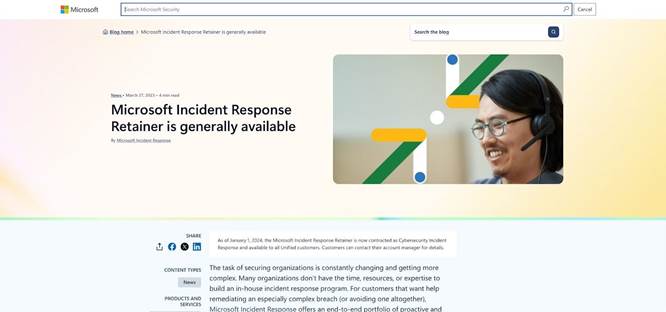
Microsoft Incident Response / DART retainer services screenshot
Under a retainer, DART pledges a two-hour remote kickoff. That first call often features engineers who helped build the very logs everyone else reverse-engineers, so root-cause analysis starts at layer zero. Direct hooks into Defender, Sentinel, and the Microsoft Threat Intelligence Center mean artifacts surface in seconds, not hours.
The engagement model is simple: sign a retainer or pay hourly. The former guarantees priority and long-term access to proactive compromise assessments, useful if you want to confirm there’s no low-and-slow actor lingering after a zero-day.
Be aware of scope. DART focuses on Microsoft stacks. If most of your estate runs AWS, Linux, or OT gear, you’ll still need a broader IR partner. For enterprises living in O365 and Azure, though, having Microsoft close the door on intruders is both efficient and reassuring to stakeholders.
Choose DART when identity and cloud are your crown jewels and you want the vendor with the source code defending them.
Wrapping up: lock in your safety net now
Cyber incidents are inevitable. Chaos is optional.
The seven retainers we explored cover every common playbook, from lightning containment to regulator-ready documentation, so there’s no excuse to greet the next breach empty-handed.
Pick the partner that matches your reality.
Run CrowdStrike if speed and tech automation rule. Reach for Deloitte when legal, PR, and forensics must march in step. Slot in Sygnia when you need elite discretion plus readiness hours that never go to waste.
Then act before the sirens.
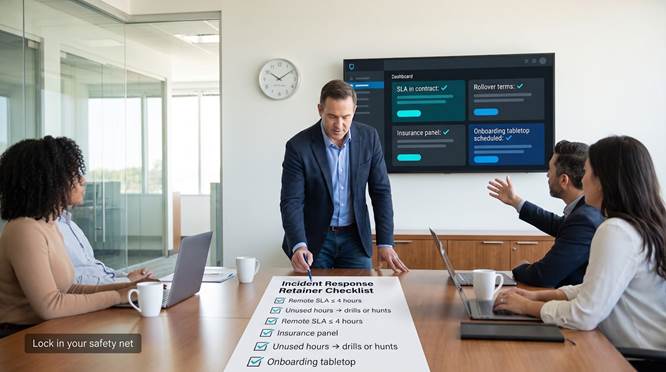
Negotiate rates, define SLAs, and schedule an onboarding tabletop within 30 days of signing. That single exercise surfaces credential gaps, firewall issues, and decision-maker confusion while the pressure is low.
Quick self-check before you sign:
- Does the contract promise remote response inside four hours, and is that time boxed in writing?
- Will unused hours roll into threat hunts or drills, not evaporate on December 31?
- Is the provider pre-approved by your cyber-insurance carrier?
- Have you agreed on the first five technical steps (log retrieval, agent deployment, bridge setup), so no one fumbles during go time?
If every box is ticked, you’ve turned an existential risk into a managed service.
Keep those numbers on speed dial.
When the next headline-grabbing exploit drops, you won’t panic, you’ll execute.