






























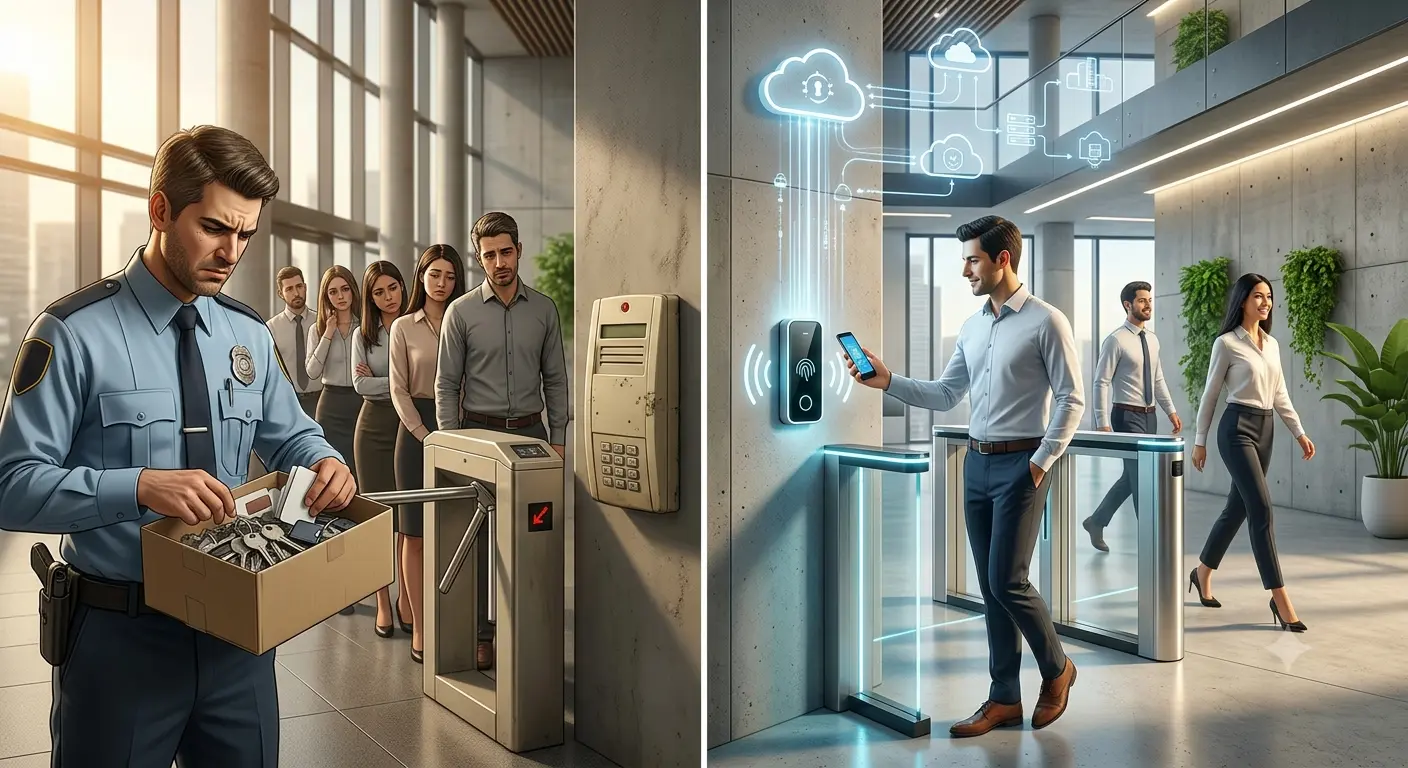
For decades, physical security in commercial facilities followed a predictable, hardware-bound formula: plastic proximity keycards, local on-premises servers installed in dedicated IT closets, and manual audit logs. While this model served property managers and enterprise operators adequately in earlier computing eras, modern commercial real estate and corporate facilities face an entirely different operational landscape. Distributed workforces, hybrid office schedules, multi-tenant leasing models, and rigorous compliance standards have exposed the maintenance burdens and security limitations inherent in legacy access architecture.
Today, enterprise facility directors and IT managers are increasingly migrating toward cloud-managed physical access. By transitioning from localized server dependencies to centralized, cloud-native architecture, organizations can achieve substantial operational efficiencies, stronger security perimeters, and greater administrative visibility across their physical infrastructure.
The Operational Limitations of Legacy Keycard Architecture
Traditional access control systems typically rely on physical credentials—most commonly 125 kHz proximity cards or standard fobs—that communicate with local door controllers wired directly to a dedicated on-premises server. While established and familiar, this localized architecture introduces several operational vulnerabilities:
- Vulnerability to Credential Duplication: Unencrypted legacy proximity cards can often be duplicated using readily available RFID cloning devices, creating untraceable physical entry risks.
- Administrative Friction and Delay: When personnel depart or contractors complete assignments, physical badges must be manually collected and processed. Lost or unreturned credentials may remain active in local databases until an administrator manually executes a deletion or privilege update.
- Single Points of Hardware Failure: On-premises access servers require ongoing localized maintenance, operating system patches, and manual data backups. If a local server suffers a hardware failure, power disruption, or database corruption, access logging can halt, and administrative changes become difficult to execute.
- Siloed Building Subsystems: Traditional access systems often operate independently from video surveillance, intrusion detection, and visitor management platforms, requiring security teams to manually cross-reference disparate software interfaces during incident reviews.
Centralized Governance and Modern Credential Options
Cloud-native access control decouples physical entry management from localized on-premises servers. In these architectures, edge door controllers communicate securely via encrypted outbound protocols to high-availability cloud infrastructure. This allows administrators to manage access permissions across single facilities or geographically distributed multi-site portfolios through a unified browser interface or administrative mobile application.
When deploying modern commercial access control systems, organizations can leverage flexible credential options, including encrypted mobile credentials alongside modern high-frequency smart cards. In appropriately configured environments, authorized users can present their smartphones via Bluetooth Low Energy (BLE) or Near-Field Communication (NFC) protocols to unlock authorized doors. Because mobile credentials leverage device-level security protections and cannot be easily cloned with simple RFID tools, access privileges can be provisioned, adjusted, or revoked in real time from a central management console.
Furthermore, cloud-based architectures provide sophisticated administrative controls when properly configured. Dynamic door scheduling allows facilities to automate unlocked periods during core business hours while enforcing higher-security verification standards—such as multi-factor validation, mobile confirmation, or biometric checks where supported—during off-hours. Role-based permissions enable administrators to restrict access to sensitive zones like server rooms, executive areas, and inventory spaces, with modern systems capable of triggering automated anomaly notifications if repeated unauthorized access attempts occur.
Native Interoperability with Video Surveillance
A notable operational benefit of cloud-first access platforms is their ability to integrate with complementary security systems through standardized APIs. Where supported by the underlying platform, cloud access control can interface directly with cloud-managed video surveillance cameras and smart intercom systems.
In these integrated deployments, an access event at a perimeter or interior door can automatically associate with the corresponding video timestamp from a nearby camera. If an access alert occurs—such as a door held open, a forced entry signal, or repeated invalid credential scans—the platform can deliver synchronized video clips and event notifications directly to security personnel and facility managers. This level of system cohesion helps streamline incident verification and reduces the time required to investigate security anomalies.
Building a Scalable Foundation for Commercial Facilities
As commercial buildings continue to transition toward connected, data-informed environments, physical security infrastructure is increasingly evaluated on scalability, manageability, and lifecycle maintenance costs. Modernizing from legacy keycards to cloud-managed access control eliminates the recurring expenses of physical badge turnover, dedicated on-premises server maintenance, and fragmented administration.
For organizations evaluating these upgrades, collaborating with experienced physical security specialists ensures that edge hardware, network topology, and cloud platforms are engineered to meet specific operational requirements. In regional commercial markets like Nevada, systems integrators such as 1st Integrated Solutions—a Las Vegas commercial security integrator specializing in modern access control, video surveillance, and integrated security solutions—assist property managers and facility teams in designing and deploying unified, cloud-ready security architectures.
By establishing a centralized, scalable physical access framework, forward-looking commercial enterprises can protect their personnel and facilities while building a flexible infrastructure adaptable to future technological developments.