



























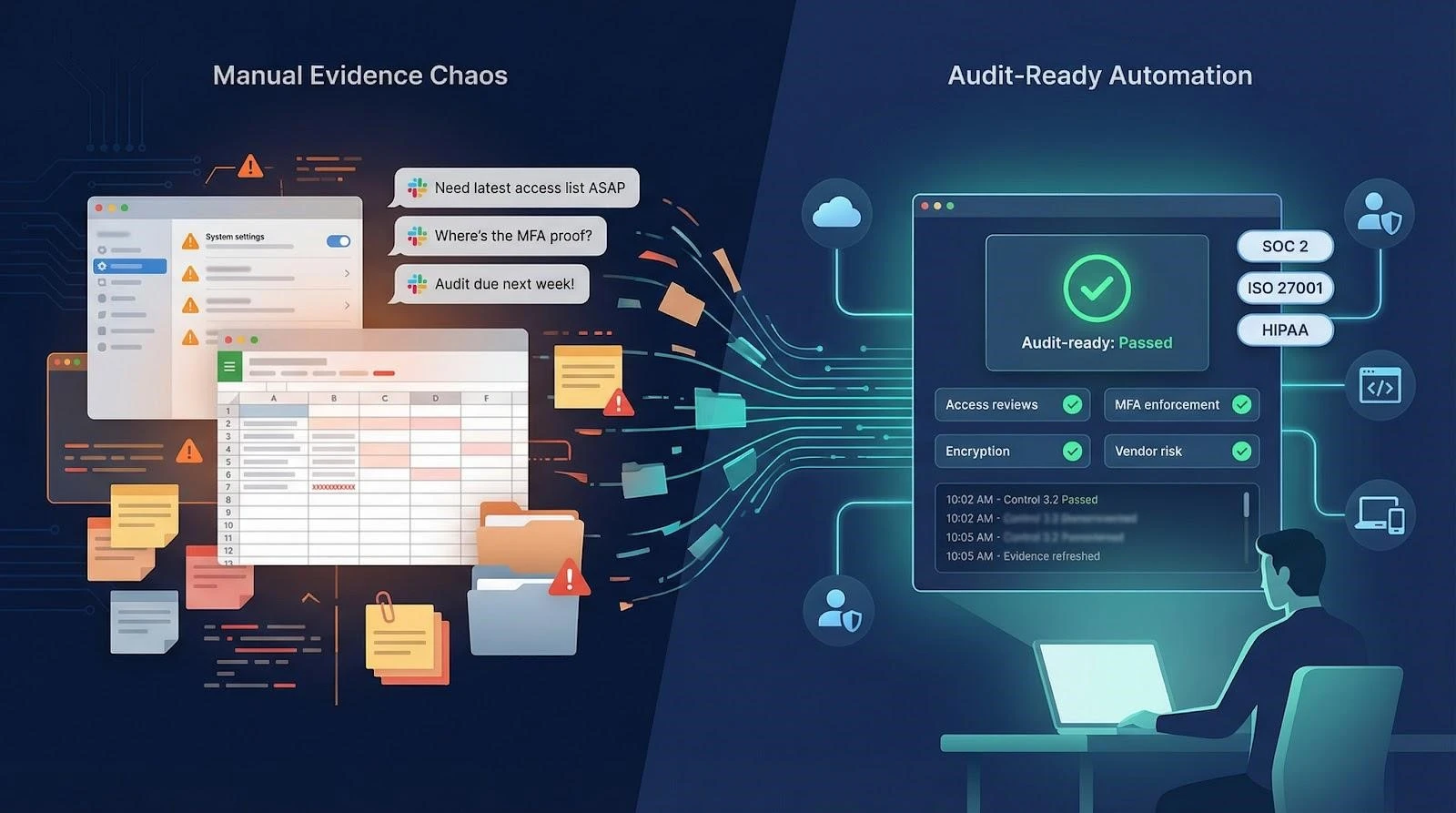
Manual evidence collection still eats 300–500 hours for a first SOC 2 audit—think screenshots, spreadsheets, and frantic Slack pings.
We found a better way. This guide compares five SOC 2 automation platforms that pull logs for you and hand auditors clean, time-stamped proof. You’ll see how each scores on evidence depth, continuous monitoring, auditor collaboration, usability, and pricing—and who comes out on top. For broader risk coverage, we also link to our 2026 list of the five best GRC tools. Ready to escape “screenshot hell”? Let’s start.
How we selected and ranked the tools (our playbook)
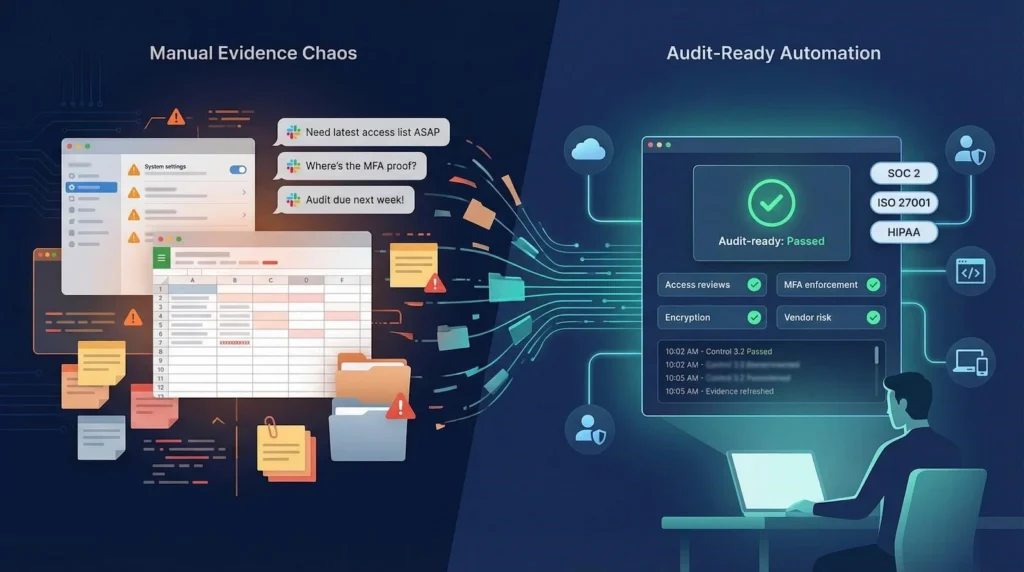
Great lists only matter if the criteria is clear, so here’s ours.
We began by reviewing the fifteen highest-ranking “SOC 2 automation” articles on Google and logged every vendor that appeared at least twice. That produced a long candidate list, yet most write-ups stopped at surface-level feature tables. We went further, reading Reddit threads where practitioners share gaps and pricing surprises, and cross-checking claims in vendor docs and G2 reviews.
Then we interviewed three independent auditors. Their verdict was blunt: a green check in an app counts only when the evidence is complete, time-stamped, and covers the full review period. That insight shaped our scoring model.
The five factors that decide the rankings
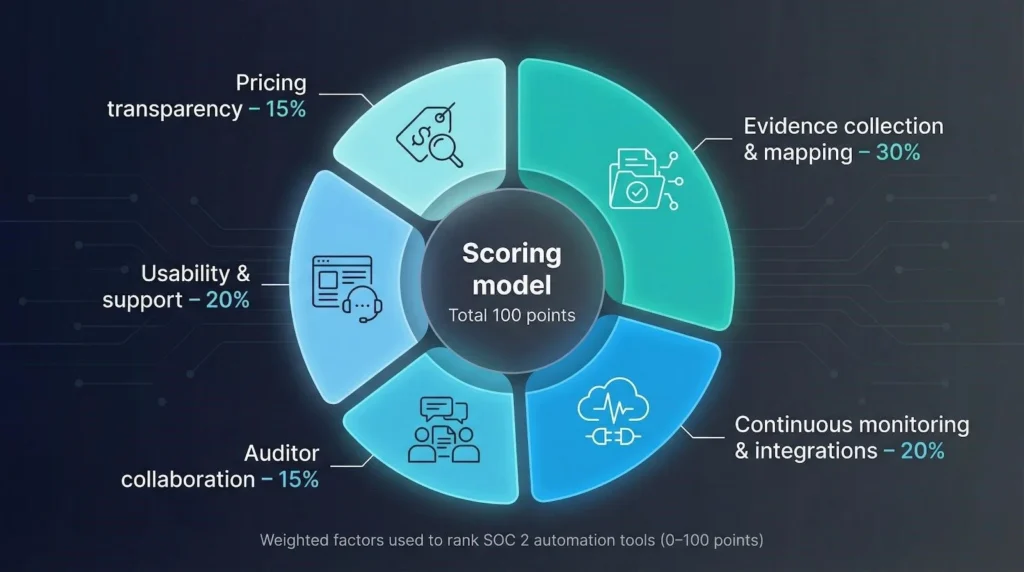
We scored each platform on a ten-point scale across five weighted pillars, then rolled those into a 100-point total:
- Evidence collection & mapping (30 percent). Does the tool automatically pull logs, configs, and artifacts for every control, and cross-map that evidence to other frameworks so you gather it once?
- Continuous monitoring & integrations (20 percent). Breadth and cadence both matter. For reference, Vanta runs 1,200 automated tests every hour across 375+ integrations, our benchmark for full-stack coverage.
- Auditor collaboration (15 percent). We looked for auditor portals, export formats auditors already use, and, perhaps most telling, the size of each vendor’s auditor partner network.
- Usability & support (20 percent). A slick UI means little if you’re stuck in setup limbo. We favored tools with responsive success teams and intuitive task flows that keep security, DevOps, and HR aligned.
- Pricing transparency (15 percent). Vendors rarely post exact numbers, but some at least share tiers or ballparks. Openness earned points, as did startup-friendly discounts that scale with headcount.
Two reviewers double-checked every score, and we broke ties by the stronger Evidence pillar. The final leaderboard is a weighted snapshot of how well each platform helps you give auditors airtight proof while keeping your team calm.
Comparison matrix: how the five tools stack up at a glance
Sometimes you just need the numbers. The table below condenses our scoring so you can spot each platform’s strengths and gaps in a single view.
| Tool | Evidence (30) | Monitoring + integrations (20) | Auditor collaboration (15) | Usability + support (20) | Pricing clarity (15) | Total /100 |
| Vanta | 27 | 20 | 12 | 16 | 12 | 87 |
| Thoropass | 25 | 17 | 13 | 17 | 11 | 83 |
| Hyperproof | 24 | 17 | 11 | 17 | 13 | 82 |
| Scrut Automation | 24 | 15 | 11 | 17 | 12 | 79 |
| Strike Graph | 23 | 15 | 11 | 16 | 13 | 78 |
A glance at the columns shows why Vanta leads: hourly tests keep its monitoring score perfect. Thoropass narrows the gap with an in-house auditor team that lives inside the same platform. Hyperproof and Strike Graph land just behind on automation but gain ground through transparent pricing and operational templates. Scrut’s wide framework list is impressive, yet its auditor mindshare still trails the front-runners.
1. Vanta: continuous checks and a deep auditor network
Vanta tops our ranking for one simple reason: it never stops testing. The platform runs more than 1,000 automated checks every hour across cloud, code, identity, and endpoints, all mapped to more than 35 frameworks. Evidence stays fresh instead of expiring in a forgotten folder.
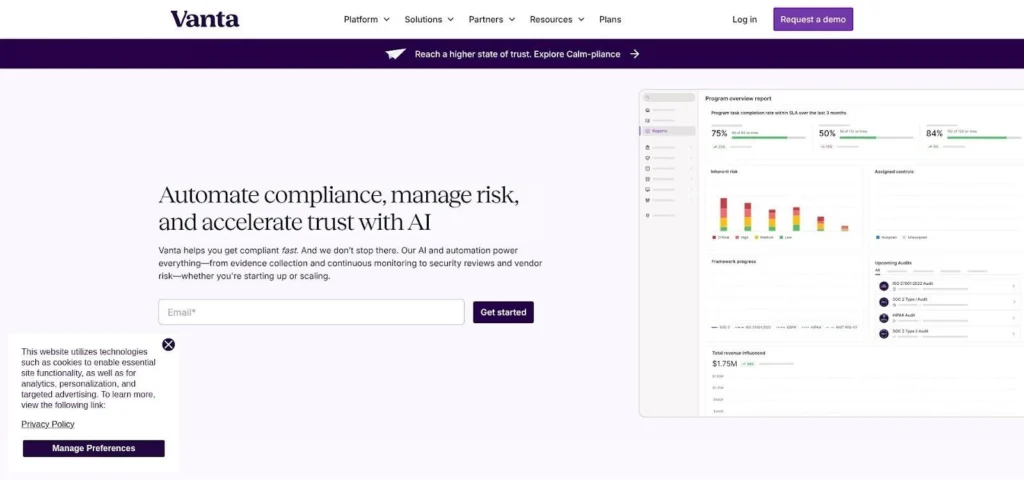
Breadth matches depth. Vanta lists more than 300 pre-built integrations, from AWS and Azure to Jamf and Jira, so you rarely fall back on manual screenshots. Connect a service once and Vanta harvests logs, configs, and access lists, then reuses the same artifacts for ISO 27001, HIPAA, or PCI when you add those frameworks later; that ability to consolidate evidence across standards is exactly what governance teams prize, and Vanta’s recent roundup of the 5 best GRC software solutions of 2026 calls cross-framework reuse a make-or-break criterion for any modern platform.
Auditors notice. More than 100 CPA firms work inside Vanta’s auditor portal, and the company reports over 20,000 audits completed on the platform. Familiarity shortens review cycles because auditors already trust the data model and don’t ask for extra PDFs.
Business traction backs up the tech story. Vanta surpassed $100 million in ARR and serves roughly 7,000 customers worldwide, milestones reached just five years after launch. Scale like that draws even risk-averse auditors into the ecosystem, creating a flywheel of acceptance.
Price is the trade-off. Community chatter puts entry packages near $10,000 per year, climbing with extra frameworks or a branded Trust Center. If the budget is tight, keep reading; otherwise, Vanta’s always-on evidence and broad auditor network make it the safest choice for a low-stress SOC 2 audit.
2. Thoropass: auditors on the platform for tighter hand-offs
Thoropass blends evidence automation with auditors who actually live inside the same workspace. Instead of exporting findings and emailing PDFs, your auditor opens the dashboard your team already uses, samples controls in place, and leaves comments that route to the right owner. The result is fewer round trips and a much shorter “request list” cycle.
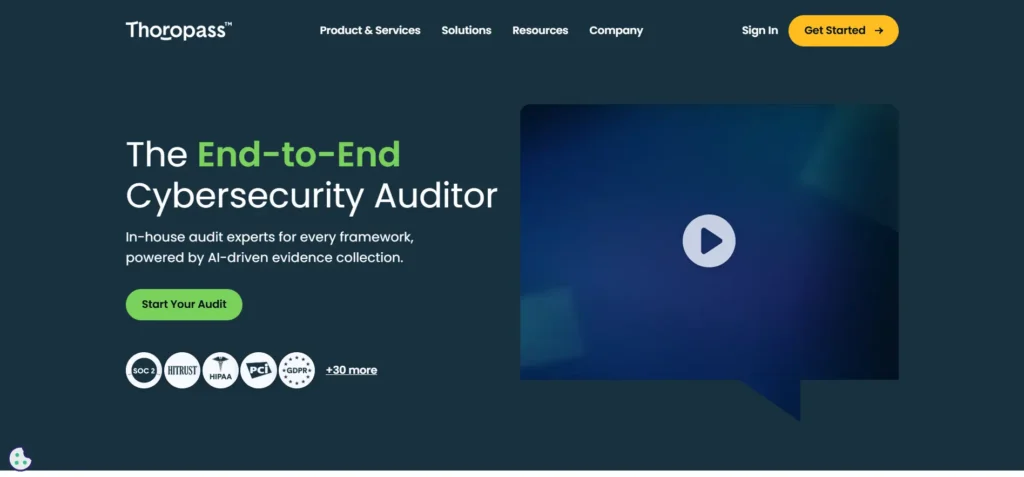
Coverage is broad. Thoropass connects to AWS, GCP, Azure, Okta, GitHub, Jira, and roughly 150 other tools, and maps a single control library across SOC 2, ISO 27001, HIPAA, PCI DSS, and GDPR. One integration often satisfies several frameworks, which keeps maintenance light when you stack standards.
The platform’s standout feature is its in-house audit team. Many customers buy software and audit as a bundle, with a fixed-fee Type I or Type II that includes weekly office hours and rehearsal walkthroughs. For first-time auditees that bundle removes the awkward step of finding a separate firm and translating between two systems.
Reporting follows the same blended logic. Thoropass flags failing controls with remediation guidance, and the auditor inside the platform can preview that evidence well before opinion drafting. Customers consistently report fewer surprises in the management response phase.
Pricing scales with headcount and frameworks, typically landing in the $7,000–$12,000 range per year before audit fees. Choose Thoropass when you want one vendor to own software, evidence, and auditor relationship—and you’d rather buy the audit instead of finding it.
3. Hyperproof: always-on evidence with operational guardrails
Hyperproof leans into compliance operations. The platform is built around a Common Control Framework that lets one piece of evidence satisfy controls across many standards, and it ships with 140+ framework templates—one of the broadest libraries on the market.
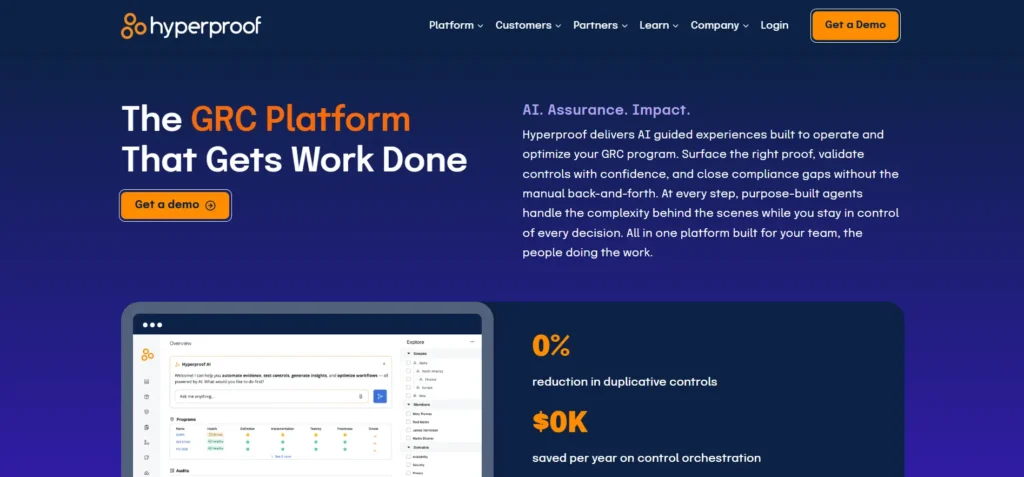
Evidence collection is solid rather than flashy. Integrations cover the usual cloud, identity, and developer tools, and scheduled pulls run as often as daily. That cadence is a step below Vanta’s hourly checks, but it suits teams who care more about repeatable workflows than streaming telemetry.
Where Hyperproof earns its keep is in operational rigor. A risk register, vendor management, audit task workflows, and a templated calendar for quarterly access reviews and annual drills all live in the same workspace. Compliance leads who already think in terms of recurring programs find the model intuitive.
Auditor collaboration is well-supported. Hyperproof maintains a CPA partner program, exports artifacts in formats auditors expect, and offers a guest portal that keeps the back-and-forth in one thread instead of spawning email chains.
Pricing is mid-market and modular. You start with the core compliance module and bolt on risk or vendor management when needed, with most growth-stage customers reporting annual fees in the mid-five figures. Choose Hyperproof when you have a compliance program to run year-round, not just an audit to pass.
4. Scrut Automation: one platform for compliance, risk, and security posture
Scrut feels less like a point tool and more like a control center. Beyond SOC 2, the dashboard already supports more than 60 frameworks, from GDPR to the new ISO 42001 for AI. When a prospect asks for another audit, you tick a box instead of buying a new app.
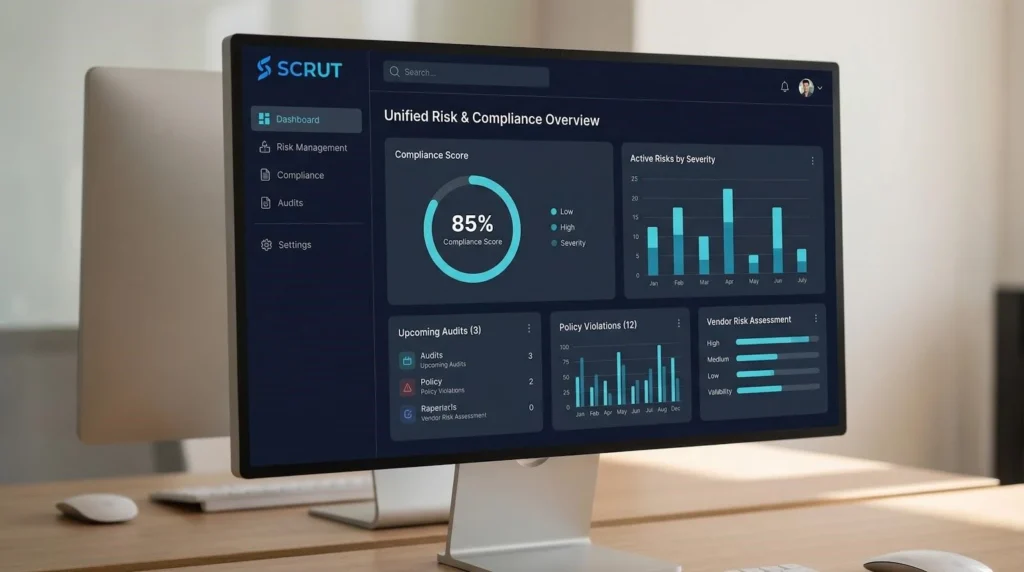
Evidence collection follows a familiar pattern: connect AWS, Okta, GitLab, Slack, and 150 additional services, then let Scrut loop through configs, logs, and user lists. The difference is risk context. Every failed control shows a heat-mapped score and a root-cause hint so you can remediate, accept, or log an exception. Auditors appreciate the trail because it proves you spotted gaps and managed them.
The built-in AI assistant, Scrut Teammates, reviews uploaded policies, flags missing clauses, and suggests wording that aligns with trust-services criteria. That saves you from tedious copy-paste policy edits.
Global reach is another plus. Founded in India, Scrut teams with audit partners across APAC, EMEA, and North America, helpful when your staff or data centers span privacy laws. Customers give the support team a 4.9-star rating on G2, often praising its “startup hustle” response time.
Pricing stays competitive because you can switch modules on or off. Start with core compliance, then add vendor risk or asset management when needed. For growing companies juggling multiple standards with limited headcount, this à-la-carte model keeps budgets sane while preparing the stack for what comes next.
5. Strike Graph: speed-to-audit for lean SOC 2 first-timers
Strike Graph is built for the company that just had a deal blocked by a SOC 2 ask. The platform pairs straightforward evidence automation with a guided “Trust Operations” workflow that gets you from kickoff to a Type I report in roughly four to six weeks.
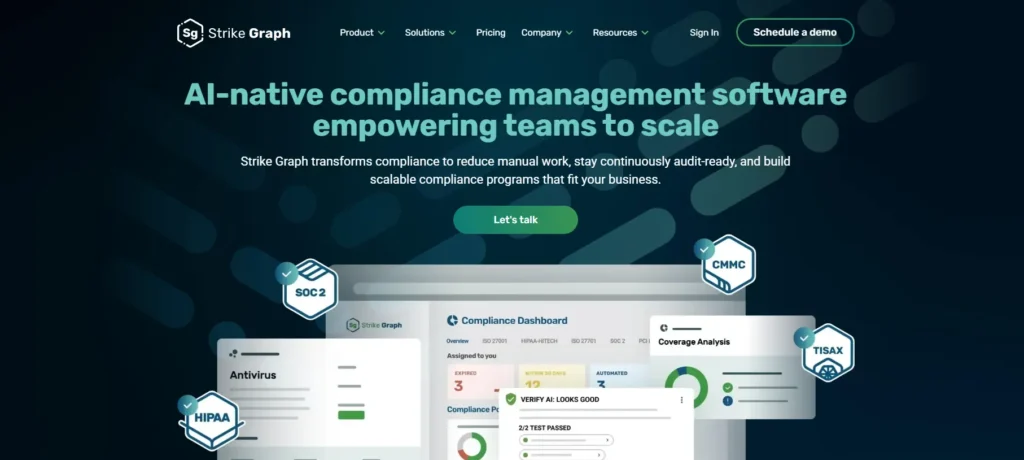
The integration set is purposefully focused but high-impact: AWS, Azure, GCP, GitHub, Okta, Google Workspace, and the other staples that cover the controls most SOC 2 reports lean on. Evidence is pulled on a schedule, mapped to the trust services criteria, and time-stamped for the auditor.
What sets Strike Graph apart is its blended audit option. The platform has its own AICPA-licensed audit firm, so you can run the assessment without changing systems. Customers who pick this path report a tighter feedback loop and a fixed-fee invoice instead of a quote-and-haggle exercise.
Usability is a clear win for non-specialists. Setup wizards, plain-English control descriptions, and a short list of “this week’s tasks” hide the underlying framework complexity. Founders and ops leads handle most of the work without needing a dedicated security engineer.
Pricing is among the most transparent in the category, with public starting tiers in the low five figures and bundles that fold in the audit. Choose Strike Graph when speed and predictability matter more than depth of integrations or AI-driven automation.
Summary: choosing the right SOC 2 automation tool
All five platforms collect evidence, map controls, and alert you when something drifts. The best fit depends on your team’s size, timeline, and need for hands-on help.
If you want maximum automation and have room in the budget, Vanta is the default pick. Hourly tests and a large auditor network remove friction for scale-ups chasing multiple frameworks.
When the audit itself feels scarier than the prep, Thoropass wins. Auditors on the platform, inline comments, and bundled fixed-fee assessments keep the examination orderly and predictable.
Need extra guidance or a year-round compliance program? Hyperproof pairs always-on evidence with templated workflows for risk, vendor management, and recurring reviews, ideal for teams that want a system to run, not just an audit to pass.
For companies juggling many standards or focused on risk posture, Scrut Automation offers the widest framework list and an AI that highlights root-cause risk, not just failed checks.
If speed and predictable pricing are your pain points, Strike Graph compresses the journey to weeks, combining a focused integration set with a bundled in-house audit that gets a lean startup over the line fast.
Shortlist two options, loop in your auditor early, and ask each vendor to demo with your actual stack. The right tool should feel like a quiet teammate that keeps you audit-ready every day.
FAQs about SOC 2 automation tools
Can these platforms fully automate a SOC 2 audit?
They remove about 70 to 80 percent of the grunt work by pulling logs, configs, and user data straight from your systems. You still approve policies, run incident drills, and review access lists, but the tools remind you, capture the proof, and time-stamp the results.
Will auditors accept evidence from Vanta, Thoropass, or the others?
Yes. More than 20,000 audits have already run through Vanta, and Thoropass, Hyperproof, Scrut, and Strike Graph each maintain growing networks of CPA firms familiar with their portals. Just confirm that every control shows coverage for the full review period, not a one-day snapshot.
How much should a startup budget for software versus the audit fee?
Plan on $5,000–$10,000 per year for the tool, then another $10,000–$20,000 for the external auditor. Costs rise with headcount, extra frameworks, and add-ons such as a public Trust Center, so share real numbers with sales teams to avoid surprises.
What happens if my stack includes a niche tool with no native integration?
Most platforms offer custom evidence upload or an API. Thoropass and Scrut let you script your own connector. Worst case, you export logs manually and attach them to the relevant control—still easier than managing dozens of spreadsheets.
Is it worth starting with a free checklist and adding a tool later?
If you are pre-revenue and fewer than ten people, a spreadsheet can tide you over. Once customers ask for a Type II report or your engineers lose hours to screenshots, automation pays for itself in reclaimed time and faster sales cycles.