



Somewhere on a fiber optic line right now, someone might be capturing your encrypted traffic without you knowing it happened. This is not paranoia.
Security researchers call it harvest now, decrypt later. It means today’s stolen data could turn into tomorrow’s breach once quantum computers grow powerful enough to crack current encryption.
Classical encryption cannot warn you when someone copies your data mid transmission. The interception leaves no trace behind.
Quantum key distribution changes that equation. Instead of leaning on math problems that quantum computers may eventually solve, QKD uses the physical behavior of light itself. Touch the signal, and you change it. Here is how that principle stops silent interception before it starts.
Key Takeaways
- Quantum key distribution reveals eavesdropping instantly because measuring a photon changes its quantum state.
- QKD defends against harvest now, decrypts later attacks that stockpile encrypted data for future quantum decryption.
- Security rests on physics, not computing power, so a faster quantum computer does not weaken it.
- QKD secures the key exchange only, so it still needs separate authentication to stop impersonation.
- Distance and hardware costs currently limit QKD to high value links like banking and defense networks.
What Is Quantum Key Distribution?
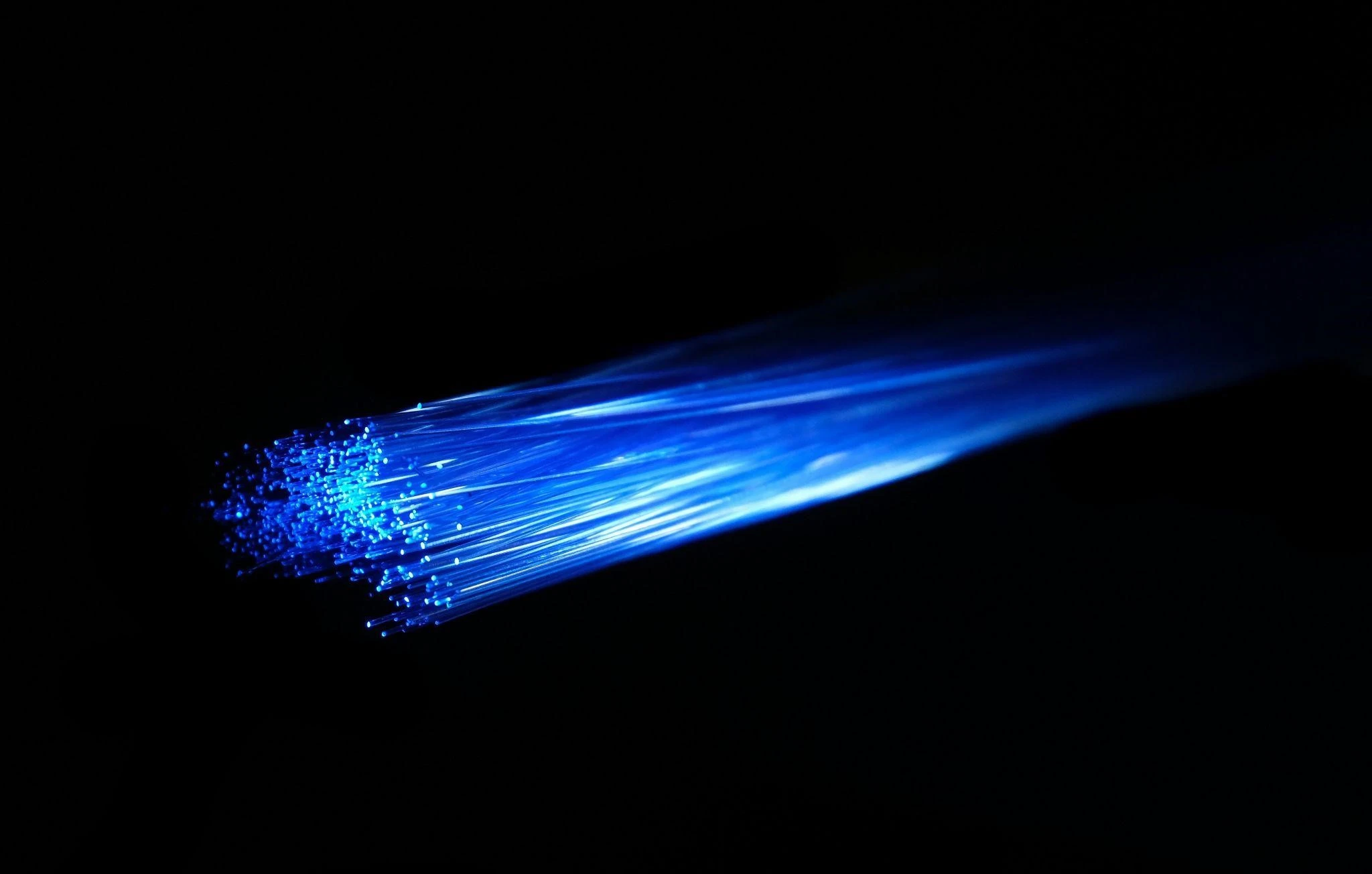
Quantum key distribution is a method for generating and sharing a secret encryption key using the quantum properties of light. Two parties exchange individual photons, each one carrying a single bit of the key encoded in its polarization or phase.
The moment someone tries to observe or copy those photons, the measurement disturbs their quantum state. That disturbance shows up as errors the sender and receiver can spot when they compare notes over a separate classical channel. Reading up on how quantum key distribution works at the level of individual photons makes the appeal obvious: eavesdropping stops being invisible.
| Quick Definition: QKD does not encrypt your data directly. It generates and delivers the secret key that a classical algorithm like AES then uses to encrypt the actual message. |
How Silent Interception Slips Past Classical Encryption
Classical encryption depends on computational difficulty. RSA and similar algorithms assume that factoring huge numbers takes too long to be practical, an assumption that will not hold forever.
Attackers do not need a working quantum computer right now to profit from this gap. They can copy encrypted traffic today and simply wait. Analysts call this harvest now, decrypt later, turning every intercepted session into a ticking clock rather than a dead end.
| Warning: Financial records, health data, and government communications often need to stay confidential for decades. That is exactly the kind of data attackers are harvesting today for decryption once quantum computers mature. |
The Physics Behind Undetectable Eavesdropping Detection
The No Cloning Principle
Quantum mechanics includes a rule with no classical equivalent: an unknown quantum state cannot be copied perfectly, unlike a photocopied document that looks identical to the original.
Try that with a photon’s quantum state and the act of copying introduces detectable noise. An eavesdropper physically cannot intercept a photon, read it, and pass along a perfect duplicate.
Comparing Measurement Bases Over a Public Channel
After transmitting a stream of photons, the two parties publicly compare a portion of the bases used to encode and measure each bit, then keep only the matching ones.
If an eavesdropper measured any photons in transit, the error rate in this comparison spikes. Guidance from the National Security Agency’s cybersecurity division confirms that once this rate crosses an expected threshold, both parties discard the session before it is ever used.
Six QKD Protocols Powering Real Deployments
Commercial and research QKD systems rely on a handful of established protocols, each with a different approach to encoding and measuring qubits.
| Protocol | Core Approach | Best Suited For |
| BB84 | Encodes bits in photon polarization | Most widely deployed commercial systems |
| E91 | Uses entangled photon pairs | Networks needing built in correlation checks |
| MDI-QKD | Routes measurement through an untrusted node | Closing detector side channel attacks |
| TF-QKD | Extends secure range past earlier distance limits | Long haul metropolitan and intercity links |
| CV-QKD | Encodes keys in laser light properties | Lower cost setups on standard telecom gear |
| DI-QKD | Verifies secrecy without trusting the hardware | Highest security use, still largely experimental |
BB84 remains the most widely deployed quantum protocol nearly four decades after its 1984 introduction.
How Far Can Quantum Key Distribution Reach?
Distance used to be QKD’s biggest weakness. Signal loss in fiber degrades the quantum state the farther it travels, and you cannot amplify a single photon without destroying the property that makes it secure.
Researchers keep pushing that ceiling higher, and the record has moved dramatically in just a few years.
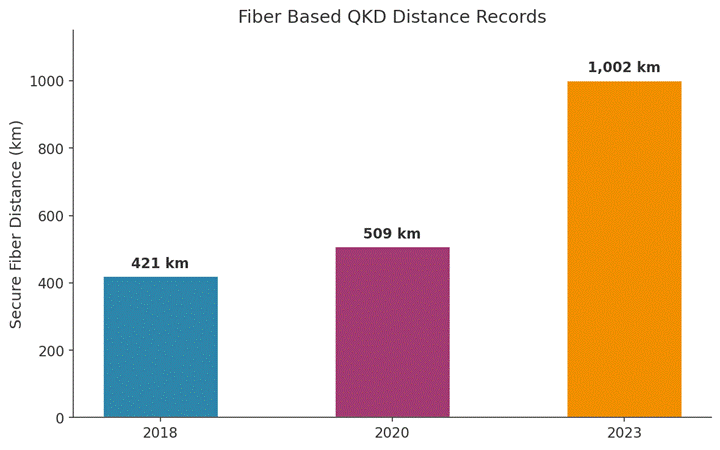
Even so, most commercial QKD deployments today still run over metro range links of roughly 100 km. Record setting experiments use specialized lab conditions that have not reached everyday network hardware yet, which is one reason security teams evaluating post-quantum protection for high value digital assets often pair QKD trials with software based defenses in the meantime.
Quantum Key Distribution vs Classical Encryption vs Post Quantum Cryptography
Every quantum safe strategy eventually has to weigh these three approaches against each other.
| Feature | Classical Encryption | Post Quantum Cryptography | Quantum Key Distribution |
| Security Basis | Mathematical difficulty | Math believed hard for quantum computers | Laws of quantum physics |
| Quantum Resistance | Vulnerable | Designed to resist | Highly resistant |
| Infrastructure Needs | Works on existing networks | Mostly compatible with current systems | Specialized hardware, often dedicated fiber |
| Typical Range | Unlimited | Unlimited | Limited by distance and hardware |
| Eavesdropping Detection | Not built in | Not built in | Detects interception directly |
Finalized post-quantum encryption standards give most organizations a software path forward that runs on infrastructure they already own. QKD asks for new hardware and dedicated links, which is why security teams usually treat it as a complement rather than a replacement.
Teams already combining zero trust access controls with encrypted tunnels can layer QKD onto that same foundation once budgets allow.
Where Organizations Are Already Putting QKD to Work
QKD is not confined to research labs. Commercial systems already protect production traffic in select industries.
- Banking: Financial institutions have tried QKD over metro fiber to protect interbank transfers on short, dedicated links.
- Shipbuilding and defense: Shipyards handling classified vessel designs have adopted quantum cryptography links to keep data confidential end to end.
- Telecommunications: Carriers have layered QKD into wide area network equipment, adding a second, physics based key alongside standard encryption.
These deployments matter because the financial and reputational fallout from a serious breach rarely stays contained to a single system, which raises the stakes for whatever link carries the most sensitive traffic.
Practical Limits Security Teams Should Weigh First
QKD is not a drop in fix. A few limitations shape where it makes sense today.
- Cost: Specialized photon sources and detectors carry a steep price tag next to software based encryption.
- Distance: Signal loss still caps unassisted fiber runs, and satellite links introduce weather related interference.
- No built in authentication: QKD secures the key exchange, not the identity of the parties involved.
- Implementation flaws: Real world hardware has shown vulnerability to detector blinding and photon splitting attacks when built incorrectly.
| Pro Tip: MDI-QKD and DI-QKD exist specifically to close detector side channel gaps, so ask any vendor which protocol their hardware runs before assuming standard protection applies. |
Smaller teams without dedicated fiber budgets can still shrink their exposure by tightening the basics covered in this rundown of cybersecurity gaps digital marketing teams often overlook.
Building a Layered, Quantum Safe Strategy
No single tool closes the quantum gap alone. QKD protects the key exchange itself, while post quantum algorithms protect authentication and everyday traffic, covering both the physical and computational sides of the threat.
Security teams weighing this shift do not need to choose one over the other. The strongest current approach combines both, so a break in one layer does not leave the whole system exposed.
FAQs
What is quantum key distribution used for?
Quantum key distribution generates and shares a secret key using the quantum properties of light. Two parties use that key with algorithms like AES to encrypt their messages, gaining protection that reveals any interception attempt.
Can quantum key distribution be hacked?
The theoretical protocol is considered secure, but real hardware has shown flaws such as blinding attacks against photon detectors. Newer approaches close most of these gaps, though no deployed system is entirely risk free.
Does quantum key distribution replace post quantum cryptography?
No. QKD secures key exchange through physics but cannot authenticate the parties involved. Post quantum cryptography handles authentication and runs on existing software infrastructure. Most security teams treat the two as complementary layers.
How far can quantum key distribution signals travel?
Commercial deployments typically run over metro distances of around 100 km without repeaters. Lab experiments have pushed secure fiber transmission well past 1,000 km using twin field protocols, though that hardware is not yet standard equipment.
Which industries use quantum key distribution today?
Banking, national defense, shipbuilding, and telecommunications already run production QKD links. These sectors typically own short, dedicated fiber routes and handle data sensitive enough to justify the required hardware investment.
Conclusion
Silent interception only stays silent because classical encryption has no way to flag it. Quantum key distribution closes that blind spot by making the physics of observation work in the defender’s favor instead of the attacker’s.
It will not replace every encryption method overnight, and it is not free of practical hurdles. But for links carrying data that has to stay secret for decades, pairing QKD with post quantum algorithms gives security teams a real answer to a threat already quietly collecting today’s traffic.
References
National Security Agency, Quantum Key Distribution (QKD) and Quantum Cryptography (QC), 2020 – https://www.nsa.gov/Cybersecurity/Quantum-Key-Distribution-QKD-and-Quantum-Cryptography-QC/
National Institute of Standards and Technology, Post-Quantum Cryptography, 2025 – https://www.nist.gov/pqc
Physics World, Encrypted Quantum Keys Sent a Record Breaking 421 km in Optical Fibre, 2018 – https://physicsworld.com/a/encrypted-quantum-keys-sent-a-record-breaking-421-km-in-optical-fibre/
Phys.org, Study Achieves a New Record Fiber QKD Transmission Distance of Over 509 km, 2020 – https://phys.org/news/2020-03-fiber-qkd-transmission-distance-km.html
Phys.org, Scientists Achieve 1,000 km Quantum Key Distribution, 2023 – https://phys.org/news/2023-06-scientists-km-quantum-key.html
Fact Check: All statistics and data points in this article were verified against original sources as of August 6, 2026. Sources are listed in the References section above.